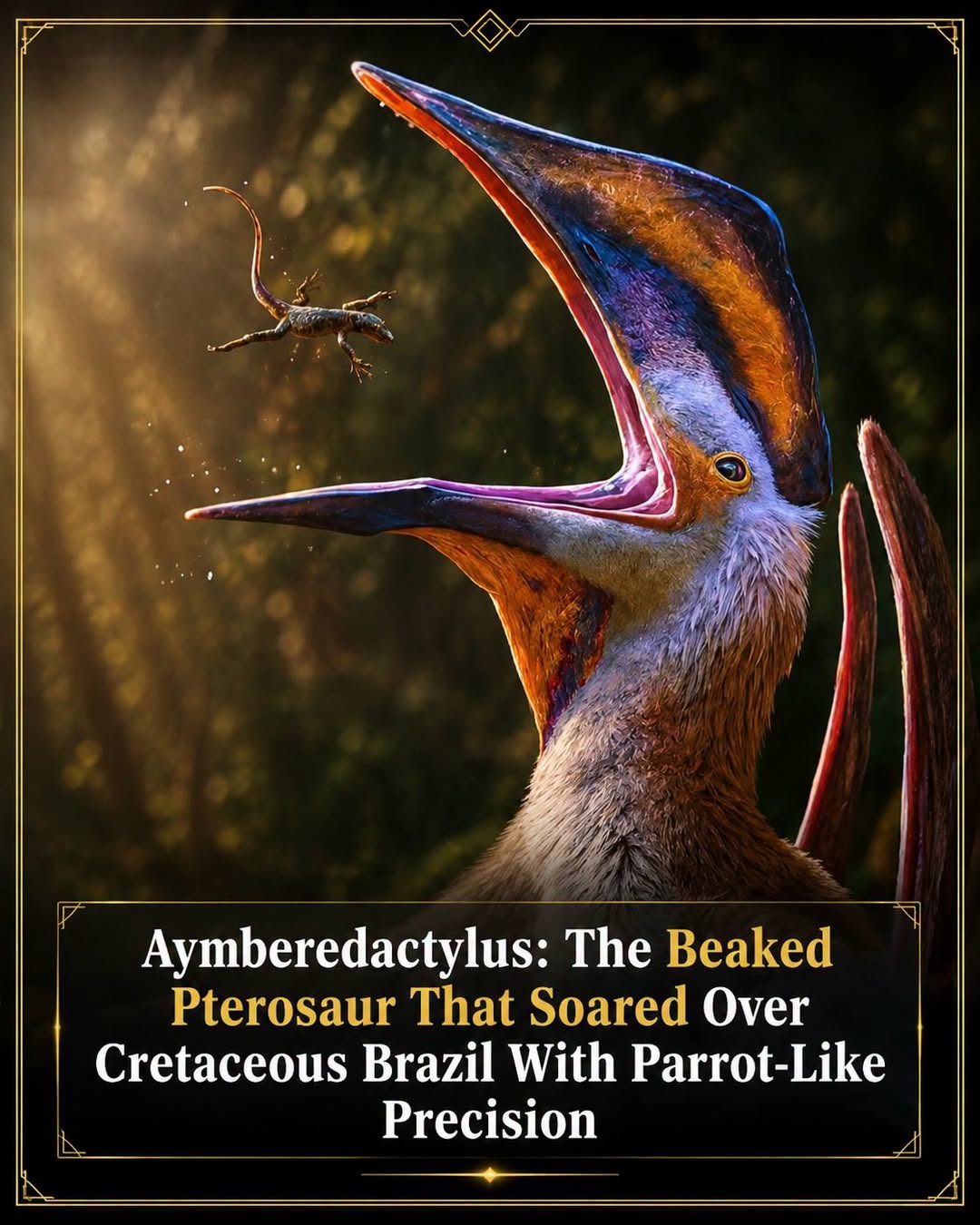
High above the lush prehistoric skies of Early Cretaceous Brazil, a curious creature once glided with grace and precision. Aymberedactylus—a tapejarid pterosaur from the Crato Formation—is one of the more recent and fascinating additions to the roster of prehistoric fliers. With a wingspan stretching up to 2 metres and a beak-shaped, toothless jaw, it stood out among the diverse airborne reptiles of its time.
Discovered in Brazil’s fossil-rich Araripe Basin, Aymberedactylus is known primarily from its remarkably preserved lower jaw, measuring 270 mm in length. Unlike many other pterosaurs with teeth, this creature had a clean, downturned beak, well-adapted for a specialised diet. Its jaw shape suggests it may have fed on soft vegetation or fruit, much like modern parrots, although its exact diet remains uncertain. The presence of a small, incomplete crest hints at display behaviours or potential sexual dimorphism, both common among tapejarids.
What makes Aymberedactylus particularly interesting is its status as a subadult. The unfused bones in its skull indicate that it had not yet reached full maturity at the time of death. This helps paleontologists better understand growth stages in pterosaurs, especially among the Tapejaridae family, which is known for its elaborate crests and varied skull shapes.
The Crato Formation, where this pterosaur was unearthed, continues to be one of the most important fossil sites for Early Cretaceous life. It provides a window into a dynamic world teeming with fish, reptiles, and a wide variety of pterosaurs like Aymberedactylus, each uniquely adapted to their environment.
Fun Fact: The name Aymberedactylus comes from the Tupi word “aymbere,” meaning “small lizard,” and the Greek “dactylus,” meaning “finger”—a nod to the long wing finger that supported its flight membrane.
#MockingMerriment
#Tapejarid #FossilDiscovery #Aymberedactylus #FlyingReptiles #PrehistoricLife #CratoFormation #CretaceousPeriod #Pterosaur #Paleontology