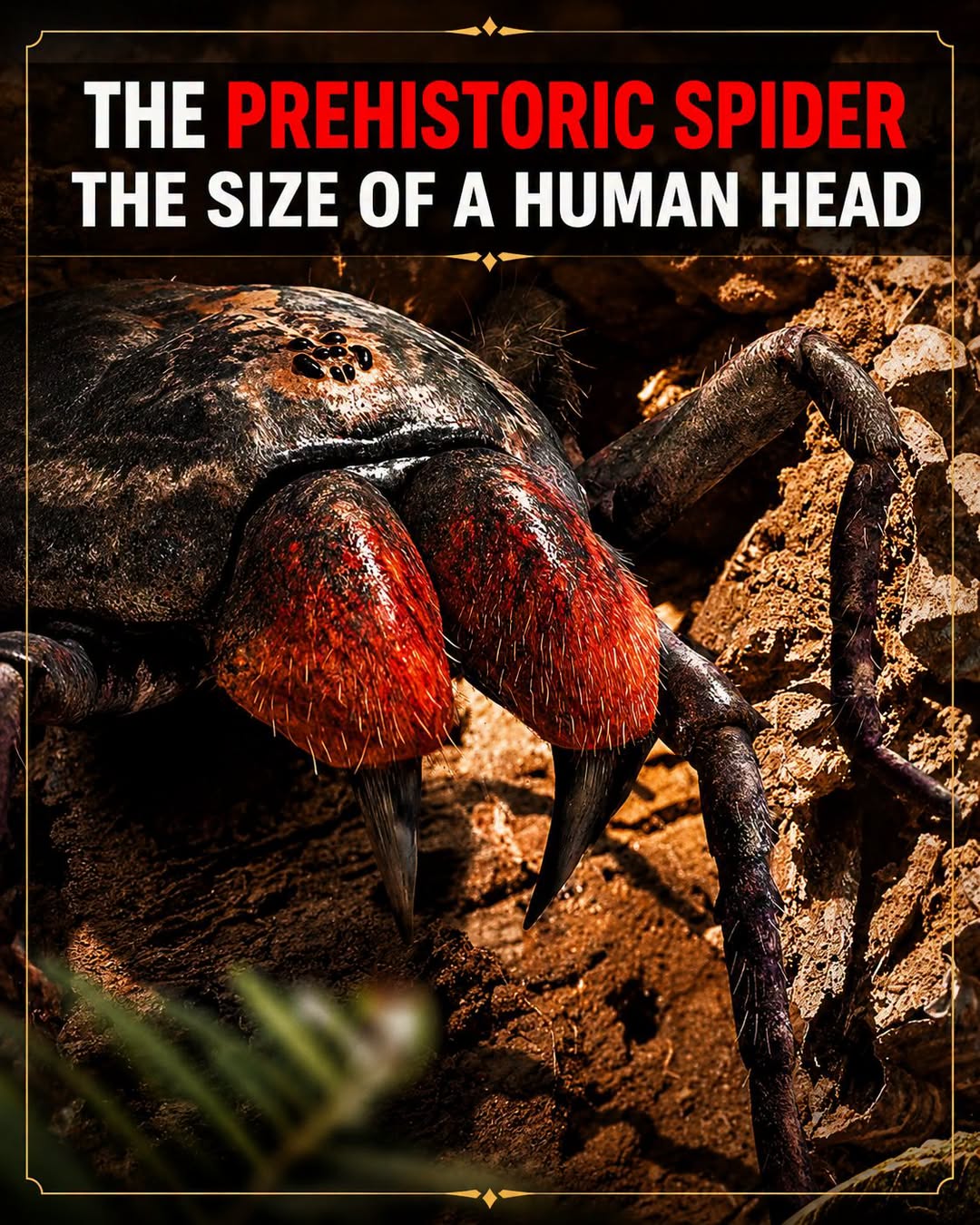
If you think modern spiders are terrifying, meet Megarachne—the true “Black Widow” of the ancient world. Believed to be the largest spider species to have ever existed, Megarachne lived during the Late Carboniferous period around 303 to 298 million years ago. Its name means “Great Spider,” and it earned that title with a body the size of a human head and a total length exceeding a foot—outclassing today’s biggest arachnids in both size and mass.
Originally discovered in the Ochil Hills of Scotland and described by American zoologist Oscar Harger in 1874, Megarachne thrived in the dense, swampy forests of what is now North America, Europe, and Russia. Despite its relatively small size compared to the era’s monstrous amphibians and arthropods, it was considered an apex predator, dominating its territory with both speed and precision.
This prehistoric spider was a marvel of evolution. It could move at speeds up to 10 mph and leap distances of around 32 feet, making it both a formidable hunter and difficult prey. Its eyesight was highly advanced, capable of providing a full 360-degree view of its surroundings—a feature rarely seen even in today’s spiders. The large fangs were likely used for subduing insects and small vertebrates, delivering swift and deadly bites.
While later studies have reclassified Megarachne as a type of sea scorpion (eurypterid), many still reference the original classification due to its dramatic resemblance to giant spiders. Its initial interpretation as a massive land-dwelling spider still captures the imagination of palaeontologists and prehistoric enthusiasts alike.
Fun Fact: Even though Megarachne is now believed to be a eurypterid—not a spider—it was considered the largest spider for nearly a century due to its spider-like features and dramatic fossil impression.
#MockingMerriment #CarboniferousPeriod #AncientPredators #Paleontology #Eurypterid #Evolution
#Megarachne #FossilFacts #GiantSpiders #PrehistoricLife
Leave a Reply
You must be logged in to post a comment.