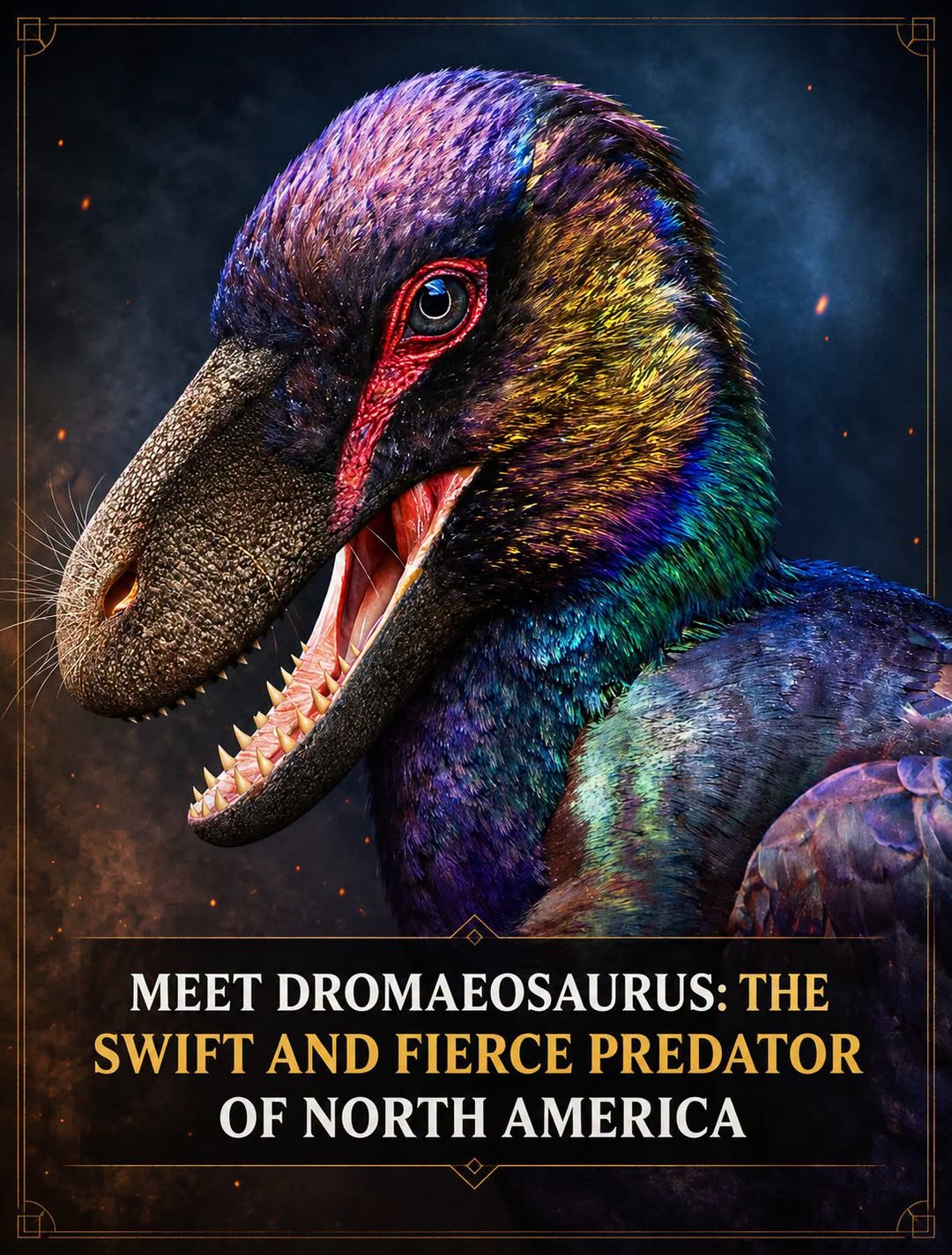
Long before humans walked the Earth, the Late Cretaceous was home to a swift and deadly predator stalking the prehistoric plains of what is now Alberta, Canada, and the western United States. This was Dromaeosaurus, meaning “swift running lizard,” a small but powerful member of the dromaeosaurid family. Measuring about 2 metres in length and weighing around 45 kilograms, this dinosaur packed a surprising punch for its size.
Though often overshadowed by its more famous cousin Velociraptor, Dromaeosaurus had its own unique traits. It lived around 80 to 69 million years ago and, like Velociraptor, it was a feathered theropod with a sickle-shaped claw on each foot—an adaptation likely used for slashing prey. However, what truly set Dromaeosaurus apart was its skull and jaw strength. Unlike many of its relatives that relied more on agility and claw attacks, Dromaeosaurus had a short, robust skull and powerful jaw muscles, suggesting that it may have delivered bone-crushing bites during the hunt.
Fossil evidence shows that Dromaeosaurus had excellent vision, strong legs for running, and serrated teeth designed for tearing flesh. It was an active predator, possibly hunting in packs, and would have fed on smaller dinosaurs, reptiles, and carrion when available. Its presence in North America at the same time as Velociraptor was hunting in Central Asia paints a picture of how similar predatory strategies evolved on different continents during the same era.
Today, Dromaeosaurus helps palaeontologists understand the diversity and evolution of raptors. Though only fragmentary fossils have been recovered, each discovery adds to our understanding of this fascinating, fast-moving carnivore.
Fun Fact: The first fossils of Dromaeosaurus were discovered in 1914, making it one of the earliest named raptors, long before Velociraptor became famous.
#MockingMerriment
#Paleontology #Theropods #Dromaeosaurus #RaptorDinosaur #FeatheredDinosaurs #DinosaurFacts #CretaceousPeriod #PrehistoricLife
Leave a Reply
You must be logged in to post a comment.