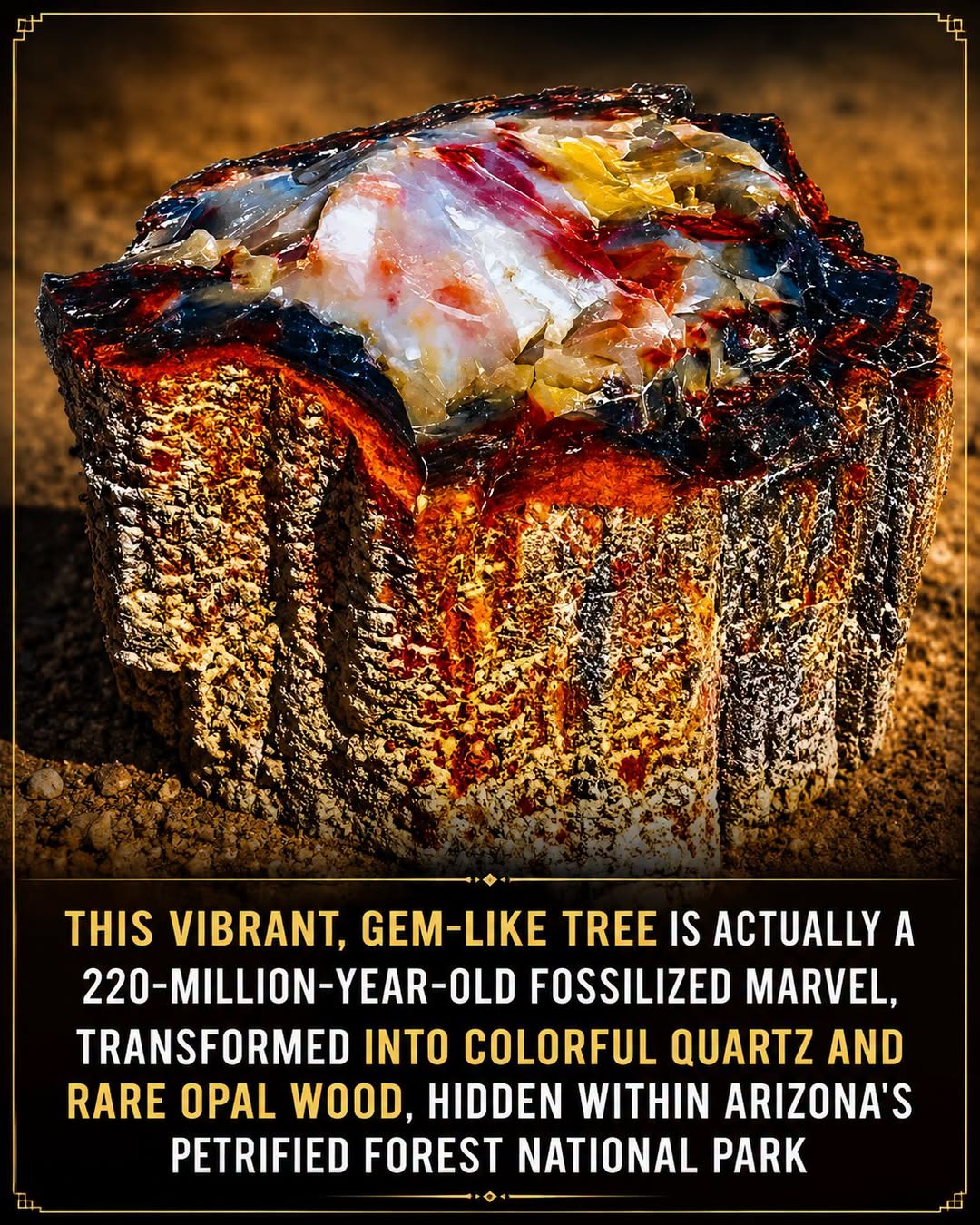
A tree that once stood tall in the Triassic wilderness, under the scorching sun of ancient Arizona, has undergone one of the most extraordinary transformations in natural history. Rather than decaying over time, this tree became immortalised in stone, revealing a journey of mineralisation that spanned over 220 million years.
This ancient tree, now part of Arizona’s Petrified Forest National Park, was buried under layers of volcanic ash and sediment. As water rich in dissolved minerals flowed through the ground, the tree’s organic tissues were slowly replaced by quartz, turning it into petrified wood. In rare cases, however, the minerals involved weren’t just silica—they formed opal, one of the most mesmerising gemstones on Earth. This opalised wood glows with brilliant colours, with the cellular structure of the tree still visible beneath flashes of iridescent reds, blues, and greens.
Petrified wood like this is not just beautiful; it is a powerful record of prehistoric ecosystems. Each mineralised ring of the trunk captures the passage of time in crystalline form. It tells us about the tree’s growth patterns, the surrounding environment, and even the volcanic events that once covered entire forests. Fossilised wood gives scientists insights into past climate conditions and the evolution of plant life long before flowering plants ever emerged.
What makes opalised wood even more valuable is its rarity. While petrified wood is found in several regions across the globe, opalised specimens are much less common and are often preserved only in isolated locations with specific geological conditions.
Fun Fact: Some opalised wood samples from Arizona are so vivid they were once mistaken for jewellery-grade gemstones and were illegally collected before strict protections were enforced.
#MockingMerriment
#FossilDiscovery #Geology #TriassicPeriod #OpalisedWood #Paleontology #FossilForest #AncientTrees #PetrifiedForest #PrehistoricLife
Leave a Reply
You must be logged in to post a comment.