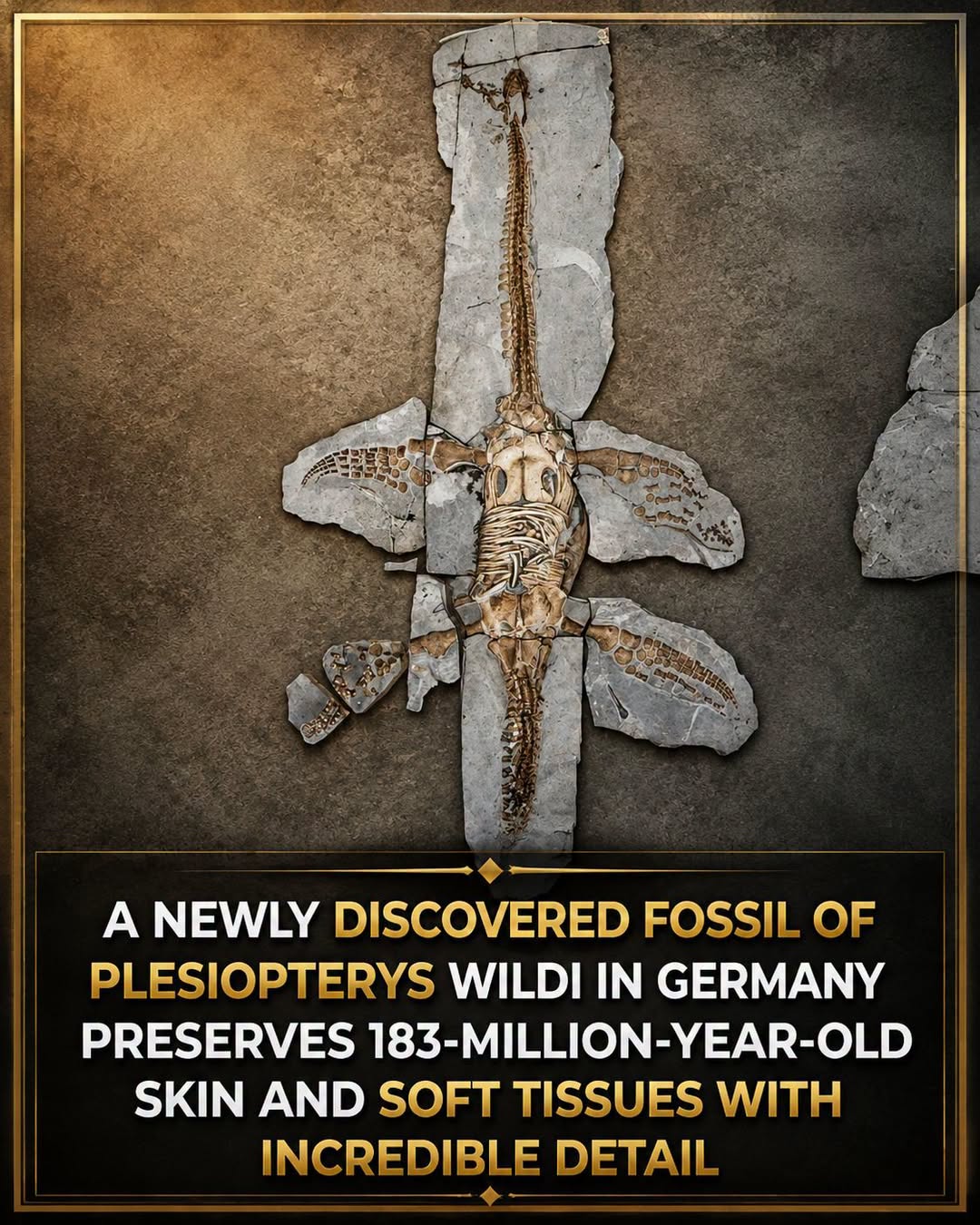
Soft tissue rarely survives deep time, but one extraordinary fossil from Germany just gave scientists a rare look beneath the surface of prehistory. A newly uncovered specimen of Plesiopterys wildi—a marine reptile from the Early Jurassic—includes preserved skin and microscopic biological features that should have vanished nearly 183 million years ago. The hookline? This fossil doesn’t just show the bones. It shows the skin, the scales, and even the pigment structures of an animal that swam when dinosaurs were just rising to dominance.
Discovered in the Posidonia Shale of southwestern Germany, this fossil captures Plesiopterys in stunning detail. Its smooth tail skin and delicately scaled flippers hint at a powerful swimmer fully adapted to aquatic life. The preservation is so precise that scientists have found melanosomes—tiny pigment-containing structures—and traces of keratin, the protein found in human skin, hair, and nails.
The presence of such organic materials offers powerful insights into the life and appearance of Jurassic marine reptiles. These animals were not just sleek and fast but may have had patterns or coloration for camouflage or communication, much like marine animals today.
This level of preservation is nearly unheard of in fossils of this age. It suggests the animal was buried rapidly after death in an anoxic, oxygen-poor seabed that prevented bacteria from breaking down soft tissues. As a result, not only did the skeleton remain intact, but even microscopic skin structures were left untouched by time.
Fossils like this challenge our assumptions about what can be preserved and show that, under rare conditions, even the most delicate features can survive for millions of years. It is a snapshot of biology suspended in stone, offering researchers new opportunities to reconstruct the soft anatomy and ecology of ancient marine reptiles with more accuracy than ever before.
Fun Fact: This fossil includes preserved melanosomes—the same structures that give squid their ink and determine human hair colour.
#MockingMerriment
#PrehistoricLife #SoftTissuePreservation #FossilDiscovery #MarineReptiles #Plesiopterys #JurassicPeriod #Evolution
#Paleontology #AncientOceans
Leave a Reply
You must be logged in to post a comment.