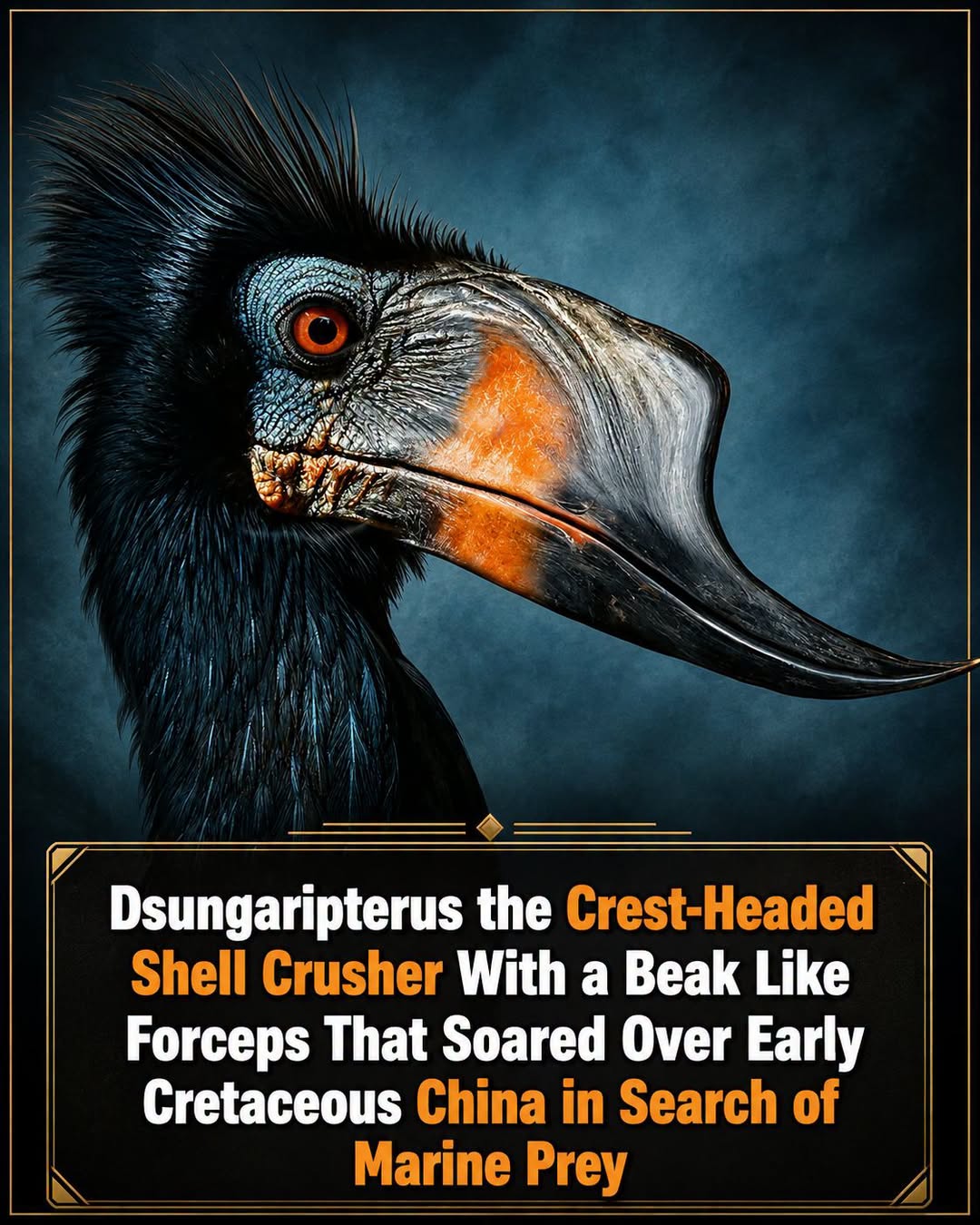
It didn’t need sharp teeth to dominate its menu. Dsungaripterus—a truly unique pterosaur of the Early Cretaceous—relied on a bizarre set of tools to hunt down its prey. With a wingspan averaging around 3 metres and a skull that looked like it was designed in a workshop of evolutionary oddities, this flying reptile has puzzled and fascinated paleontologists for decades.
The hookline? Dsungaripterus didn’t need claws or fangs to survive. It cracked shellfish open with a mouth full of bone. Living in what is now China roughly 120 million years ago, Dsungaripterus soared above lagoons and coastal waters in search of food. Its jaws were long, upturned at the tips, and ended in a narrow beak that resembled specialised forceps. Instead of conventional teeth, it had thick, rounded bony projections or “knobs” located at the back of its jaws. This unusual adaptation likely allowed it to pick shellfish off rocks or mud and crush them with ease.
It wasn’t just its mouth that stood out. Dsungaripterus also sported a thin bony crest running along the top of its skull, with another projecting just behind it. The exact purpose of these crests remains a mystery, but they may have been used for display, species recognition, or even aerodynamic balance during flight.
Despite being a pterosaur and not a dinosaur, Dsungaripterus was part of the diverse and dynamic ecosystems of the Early Cretaceous. It played a vital role as a specialised feeder, showing how evolutionary innovation allowed flying reptiles to carve out unique niches in prehistoric environments. Its flight style is also believed to have been different from other pterosaurs—rather than high soaring, it may have engaged in short, strong bursts of flapping while spending much of its time foraging along shorelines and tidal flats.
Fun Fact: The upturned tips of its jaws and shell-crushing knobs have no modern equivalent, making Dsungaripterus a one-of-a-kind in the fossil record. No living animal has exactly this combination of features.
#MockingMerriment
#AncientFliers #Dsungaripterus #Paleontology #Evolution #PrehistoricLife #Pterosaur #UniqueAdaptations #CretaceousPeriod #FossilDiscovery
Leave a Reply
You must be logged in to post a comment.