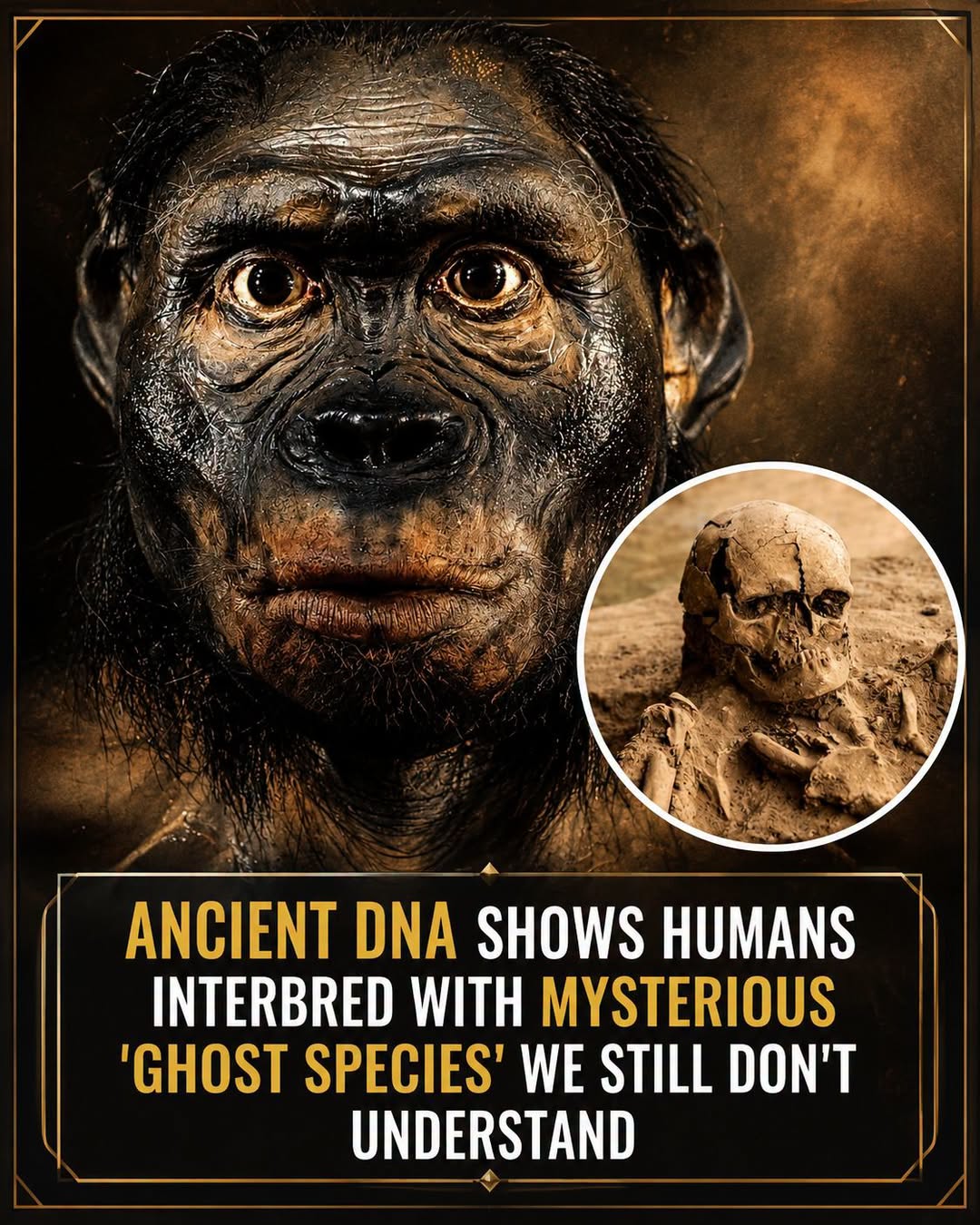
Long ago, early humans mated with a mysterious hominin group that has no name, no fossils, and no face. This ancient population doesn’t match Neanderthals, Denisovans, or any other known species. Yet, their DNA still lives on in us today, silently carried by millions of people across the globe.
Scientists first uncovered signs of this unknown group by analysing the genomes of modern humans from sub-Saharan Africa, Asia, and Oceania. What they found were genetic sequences that couldn’t be traced to any recognised human ancestor. This “ghost population”—sometimes called archaic introgression—contributed to the human gene pool tens of thousands of years ago, but left no physical trace behind. No bones, no teeth, no tools—just fragments of DNA that don’t belong to anyone we’ve ever identified.
Recent research has deepened the mystery. Using advanced genome mapping and artificial intelligence, scientists now believe this unknown group interbred with our ancestors as recently as 20,000 to 40,000 years ago, suggesting they were a widespread and possibly long-surviving population. Even more puzzling is the possibility that there may have been more than one unknown group, each mixing with modern humans at different times and locations.
This challenges our understanding of human evolution. Instead of a simple line from ancient apes to modern Homo sapiens, we’re now seeing a web of ancient encounters, with interbreeding between various hominin species—including ones we still know nothing about. The human family tree is far more tangled than we ever imagined, and we may still be carrying the legacy of a people who vanished without a trace.
Fun Fact: Some of these mysterious genes are linked to immune system responses, meaning this unknown group may have helped early humans adapt to new diseases and environments.
#MockingMerriment
#PrehistoricLife #GhostPopulation #Archaeology #AncientDNA #Evolution #HumanOrigins #Paleontology #EarlyHumans #Genetics
Leave a Reply
You must be logged in to post a comment.