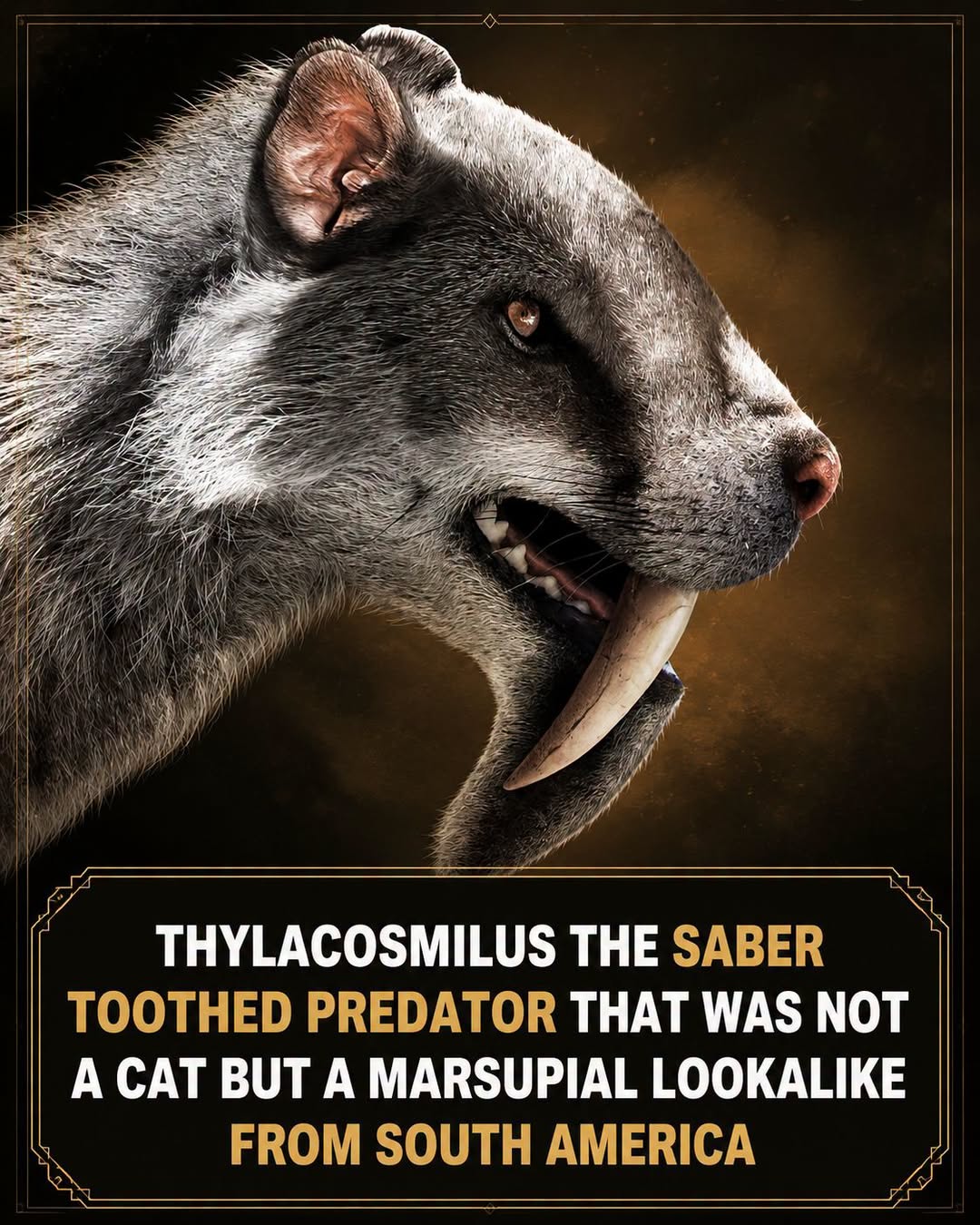
It had the terrifying fangs of a saber-toothed cat but was not a cat at all. Thylacosmilus was one of the most bizarre and misunderstood predators in prehistoric South America, with features that could fool even seasoned palaeontologists at first glance.
Thylacosmilus lived between 9 and 3 million years ago during the Late Miocene to Pliocene epochs. Fossils have been found in Argentina, revealing a predator that resembled the famous Smilodon, or saber-toothed tiger, of North America. But appearances can be deceiving. Thylacosmilus was not a felid—and not even closely related to cats. It belonged to a group called sparassodonts, extinct carnivorous metatherians that were more closely related to marsupials like kangaroos and opossums than to any modern-day predator.
What makes Thylacosmilus so fascinating is how closely it mimicked the appearance of true saber-toothed cats despite being evolutionarily distant. This phenomenon is known as convergent evolution, where unrelated species develop similar traits due to living in similar environments and facing similar challenges.
Thylacosmilus had long, dagger-like upper canines that extended well below its lower jaw and likely used them to take down prey with powerful stabbing bites. Unlike most saber-toothed mammals, Thylacosmilus had deep grooves in its lower jaw that acted like protective sheaths for its enormous teeth. These adaptations suggest it was a specialist predator, possibly ambushing slower prey rather than chasing it down. Its strong neck muscles and robust forelimbs would have played a crucial role in subduing its victims.
Fun Fact: Despite its fearsome look, some researchers believe Thylacosmilus may have had relatively weak bite force and relied more on precision and neck strength than jaw power to kill prey.
#MockingMerriment #ConvergentEvolution #Paleontology #PrehistoricLife #MarsupialEvolution
#MioceneEpoch #Thylacosmilus #AncientPredators #SaberToothedPredator #FossilDiscovery
Leave a Reply
You must be logged in to post a comment.