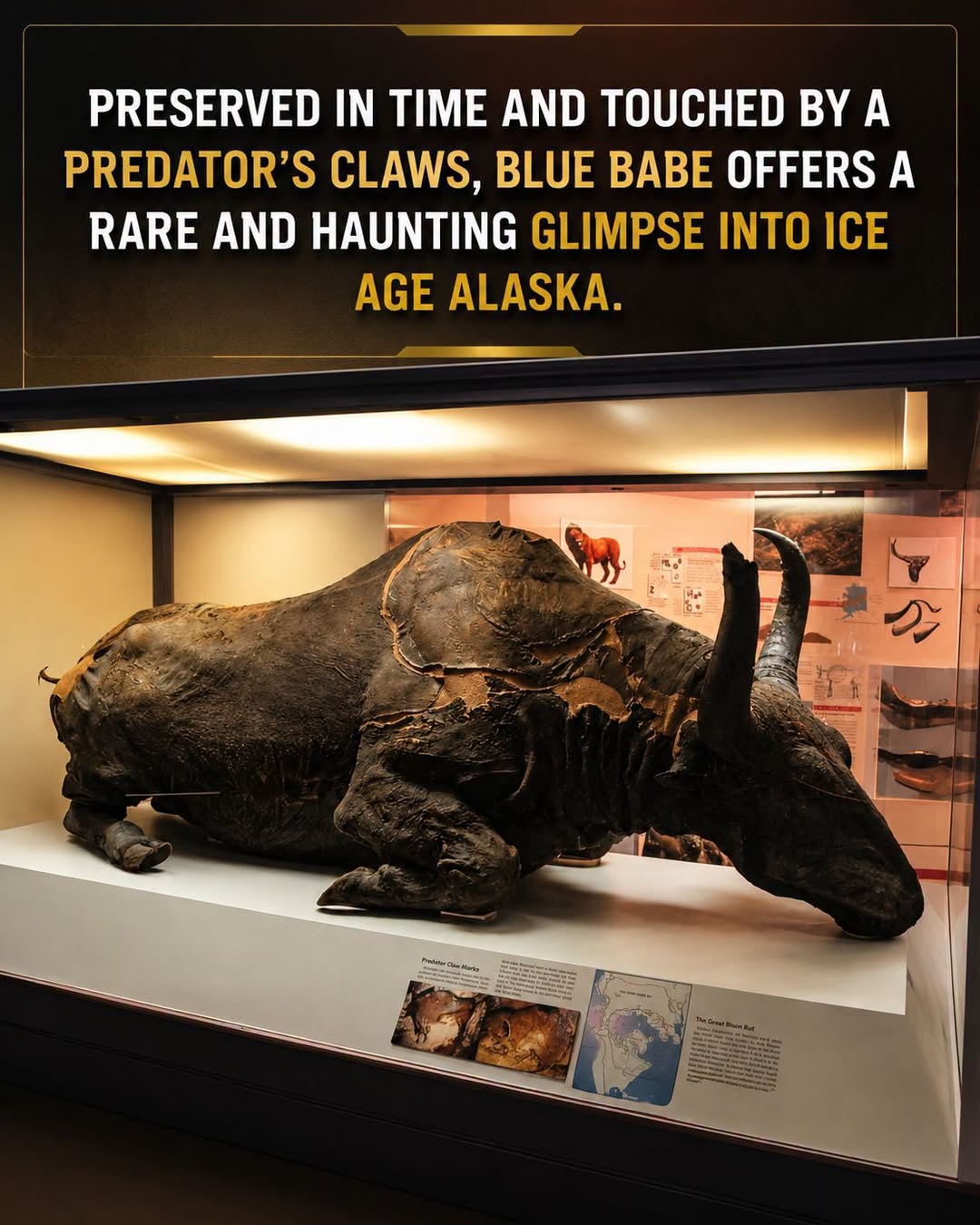
In 1979, gold miners working near the Dalton Highway in Alaska made a discovery that stunned scientists. Beneath the frozen soil, they uncovered the incredibly well-preserved remains of a mummified steppe bison, later nicknamed Blue Babe. This Ice Age relic had been entombed in permafrost for approximately 36,000 years, its name inspired by the blue mineral vivianite that formed on its exposed skin as it reacted with ground minerals.
What makes Blue Babe even more remarkable is not just its preservation, but the forensic clues it carries. Deep claw and tooth marks etched into the carcass reveal that this bison fell prey to an apex predator of the Pleistocene epoch—the American lion (Panthera atrox). This now-extinct feline was one of the largest cat species to have ever lived, even larger than today’s African lion. The injuries on Blue Babe tell a vivid story of predator and prey frozen in time.
Scientists at the University of Alaska Fairbanks meticulously studied the bison’s remains, using radiocarbon dating, tissue analysis, and predator damage assessments to reconstruct the final moments of this Ice Age giant. Today, Blue Babe is proudly displayed at the University of Alaska’s Museum of the North in Fairbanks, where visitors can witness this tangible piece of prehistory.
The exceptional preservation of Blue Babe offers rare insight into Ice Age ecology, predator-prey relationships, and the powerful grip of permafrost in locking away organic history for tens of thousands of years. It stands as a scientific treasure, linking us directly to a colder, wilder North America that once teemed with megafauna.
Fun Fact: During the preservation process in the 1980s, researchers even cooked and tasted a small portion of Blue Babe’s flesh as part of a unique experiment—marking one of the strangest scientific dinners ever recorded.
#MockingMerriment
#FossilDiscovery #BlueBabe #Megafauna
#AmericanLion #Paleontology #SteppeBison #IceAge #Permafrost #PrehistoricLife
Leave a Reply
You must be logged in to post a comment.