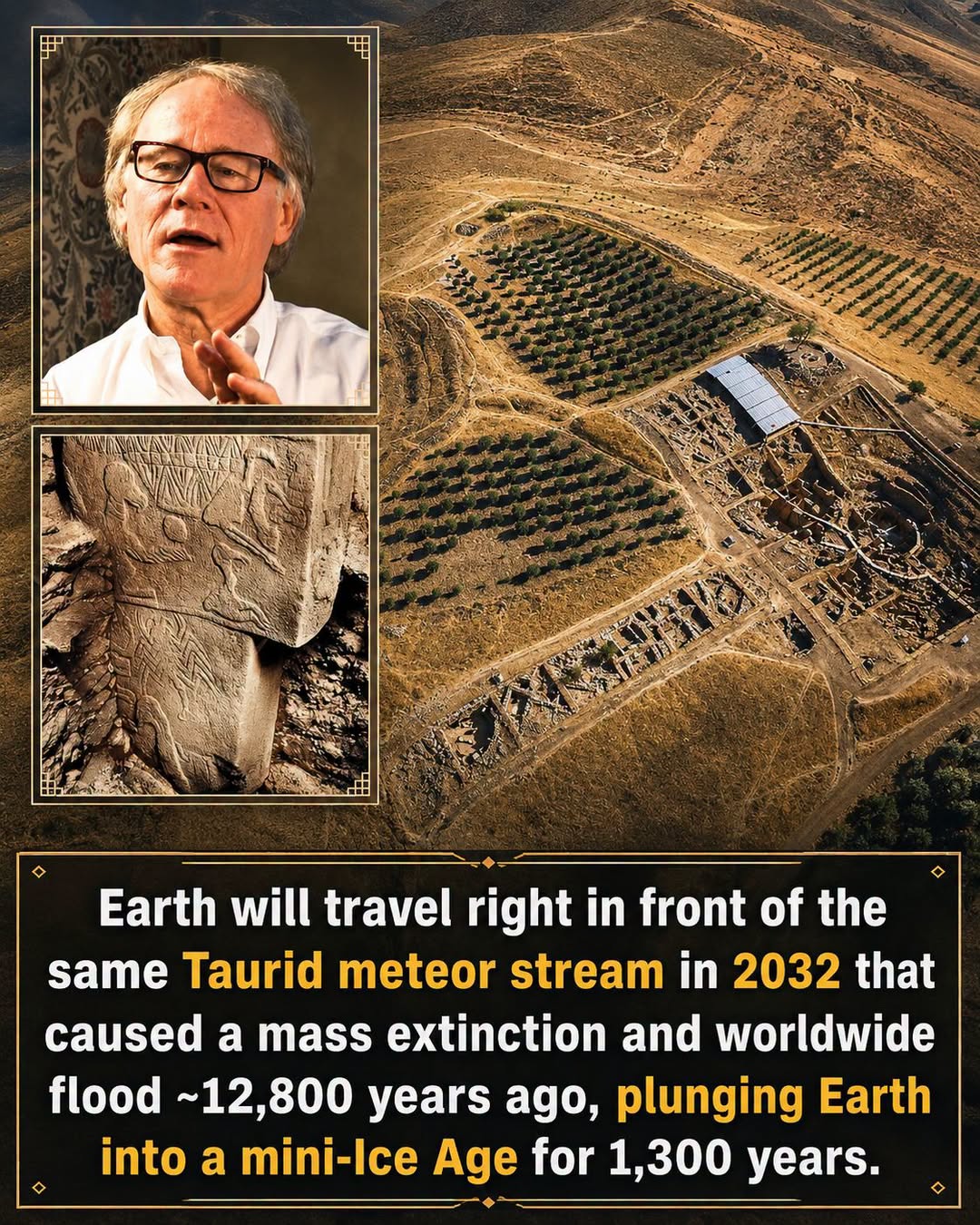
What if ancient temples weren’t just places of worship, but warnings carved in stone? For decades, Graham Hancock has argued that our ancestors may have been far more advanced than we give them credit for—and now, a growing body of research suggests he might have been onto something.
At the heart of this theory lies Göbekli Tepe in modern-day Turkey, the world’s oldest known temple, dating back some 12,000 years . Researchers now believe its intricate stone carvings might be more than artistic or religious—they could be an ancient astronomical record.
One of its most famous pillars, the “Vulture Stone,” is thought to depict a catastrophic comet strike that occurred around 10,850 BC, triggering a sudden mini Ice Age known as the Younger Dryas . This event, lasting over 1,200 years, may have wiped out many species and forced early humans to shift toward agriculture, sparking the birth of civilization .
Even more astonishing: the carvings appear to represent a 365-day solar calendar with 12 lunar months, and researchers believe the builders understood axial precession—the gradual shift in Earth’s rotational axis—at least 10,000 years before it was formally documented by Greek astronomer Hipparchus in 150 BC . One pillar even depicts the Taurid meteor stream, the likely source of the comet fragments, showing a 27-day event emanating from specific constellations .
If correct, the builders of Göbekli Tepe were not just spiritual, but scientifically advanced—preserving celestial knowledge that may have been passed down from an earlier, lost civilization.
Strange but fascinating fact: Some scholars believe the animal symbols on Göbekli Tepe’s pillars represent specific star groups. If true, this would mean early humans were mapping the heavens with precision long before the invention of writing—and possibly leaving encoded warnings for future generations .
#MockingMerriment
#YoungerDryas #Archaeology #FossilDiscovery #GobekliTepe #LostCivilizations #AncientAstronomy #HumanHistory #PrehistoricLife #AncientCivilizations
Leave a Reply
You must be logged in to post a comment.