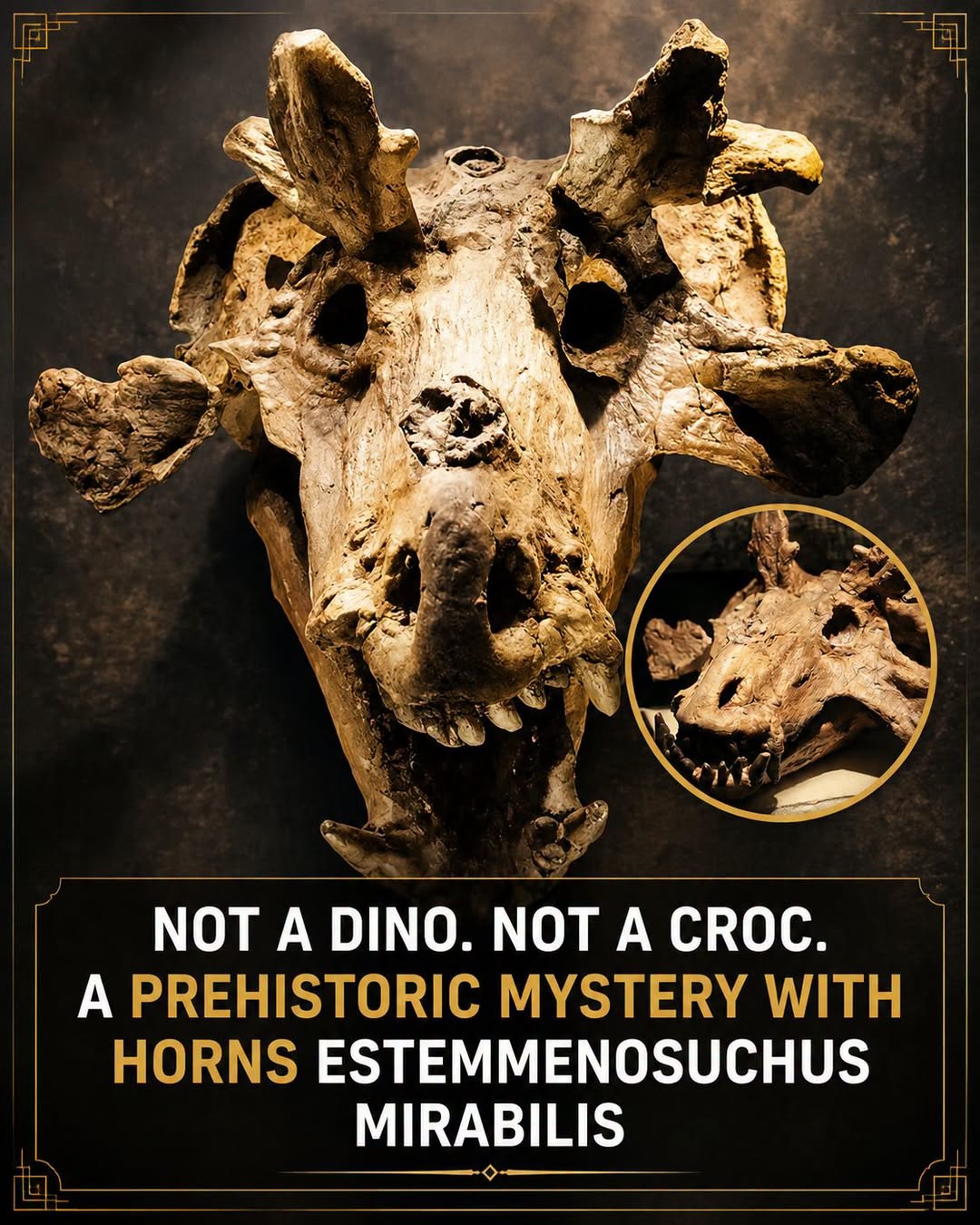
Long before dinosaurs dominated the planet, an unusual creature with crown-like horns ruled the Permian landscapes. Estemmenosuchus, meaning “crowned crocodile,” was neither a crocodile nor a dinosaur. Instead, it belonged to an ancient group called therapsids—the distant ancestors of mammals—revealing a surprising chapter in Earth’s evolutionary story.
Estemmenosuchus lived over 267 million years ago during the Middle Permian period in what is now Russia. This bizarre herbivore had a powerful, heavyset body and distinctive horn-like projections on its skull that made it stand out among prehistoric fauna. Despite its fearsome appearance, it was a slow-moving plant eater, challenging the common assumption that horned prehistoric animals were always carnivores.
There are two main species of Estemmenosuchus. The larger, more famous species, Estemmenosuchus mirabilis, could reach lengths of up to 5 metres and weigh between 500 and 750 kilograms. Its elaborate skull horns might have been used for display or defense, though their exact function remains debated. The smaller Estemmenosuchus uralensis was about 3 to 3.5 metres long and lighter in build, with some primitive skeletal features setting it apart.
This creature illustrates how evolution does not follow a straightforward path. Estemmenosuchus and its kin are part of the lineage that eventually led to mammals, making them crucial links between reptile-like ancestors and the warm-blooded creatures we know today. Their existence reminds us that some of the weirdest and most fascinating life forms appeared long before the rise of dinosaurs.
Fun Fact: The “crowned crocodile” name was inspired by its impressive skull horns, but Estemmenosuchus had a herbivorous diet, feeding mainly on tough Permian plants.
#MockingMerriment #MammalAncestors
#PermianPeriod #Estemmenosuchus #Paleontology #PrehistoricLife #Evolution #Therapsids #FossilDiscovery #AncientCreatures
Leave a Reply
You must be logged in to post a comment.