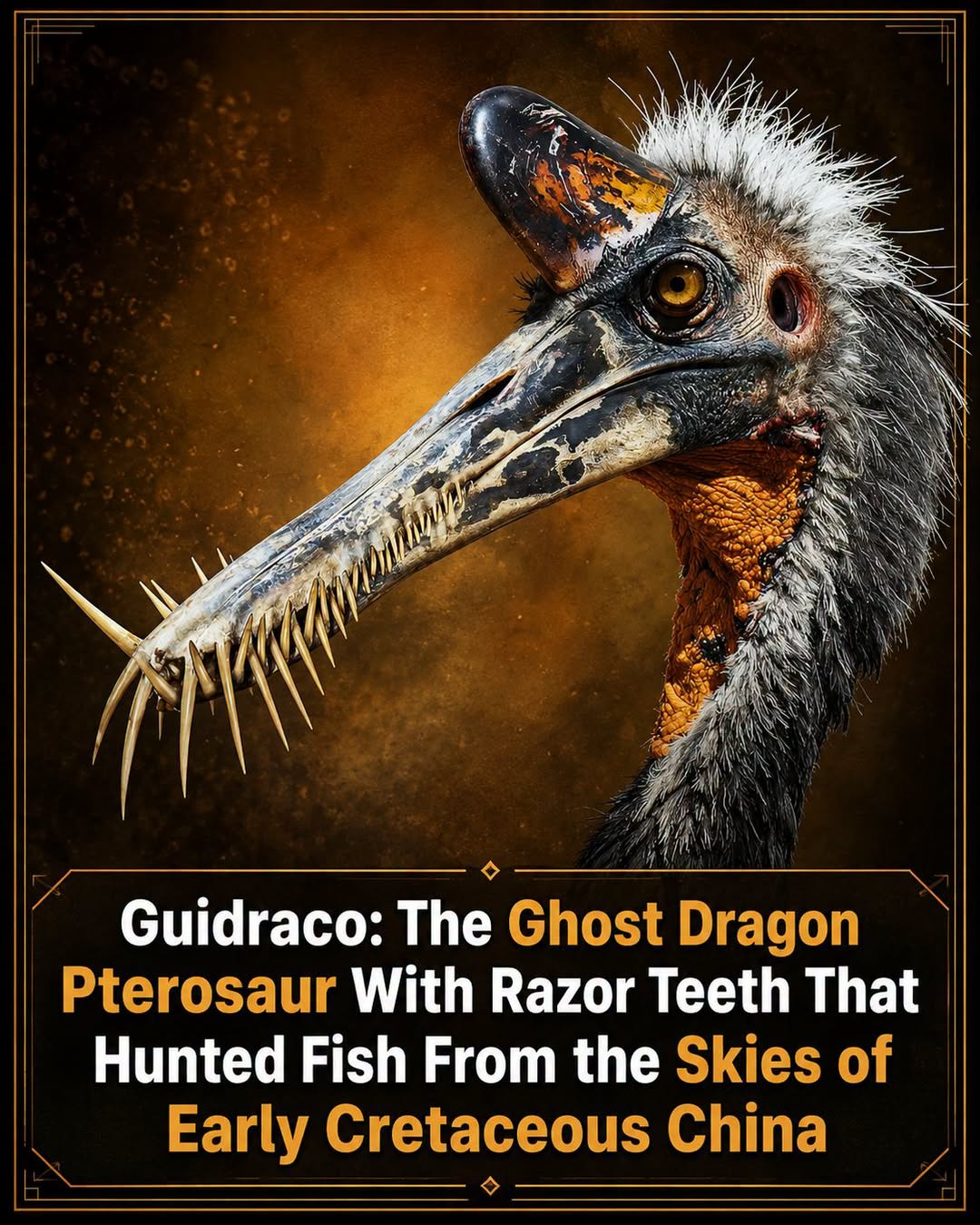
With a wingspan stretching up to 5 metres and a skull full of razor-sharp, forward-pointing teeth, Guidraco was one of the most fearsome aerial fish hunters of the Early Cretaceous. Discovered in what is now China, this pterosaur earned the name “ghost dragon” for its eerie appearance and ancient lineage, gliding silently over prehistoric lakes and coastlines in search of prey.
Guidraco stood out from other pterosaurs thanks to its long, narrow snout filled with interlocking teeth designed to snatch slippery fish right out of the water. Whether it skimmed just above the surface or hovered patiently for the perfect moment to strike, its hunting strategy was a testament to its specialised evolution. The structure of its jaws allowed it to trap fish with minimal resistance, making it a highly efficient predator in aquatic environments.
Adding to its dramatic profile was a bony crest on the back of its head. While the exact purpose of the crest remains uncertain, paleontologists believe it may have been used for visual display during mating rituals or to aid in stabilising the animal during flight. Its long wings and lightweight skeleton allowed Guidraco to be an agile and energy-efficient flyer, covering large areas as it searched for food in the lush wetlands of Cretaceous Asia.
The discovery of Guidraco has added important depth to our understanding of pterosaur diversity. It reveals how these ancient reptiles adapted to different ecological roles, not just as high-flying gliders but as specialised hunters in coastal and freshwater environments. Each new fossil find helps paint a clearer picture of how these fascinating creatures thrived in Earth’s distant past.
Fun Fact: Guidraco’s teeth were so long that some nearly overlapped when its mouth was closed, creating a natural cage to trap fish without letting them escape.
#MockingMerriment
#CretaceousPeriod #PrehistoricLife #DinosaurFacts #FlyingReptiles #FossilDiscovery
#AncientPredators #Guidraco #Pterosaur #Paleontology
Leave a Reply
You must be logged in to post a comment.