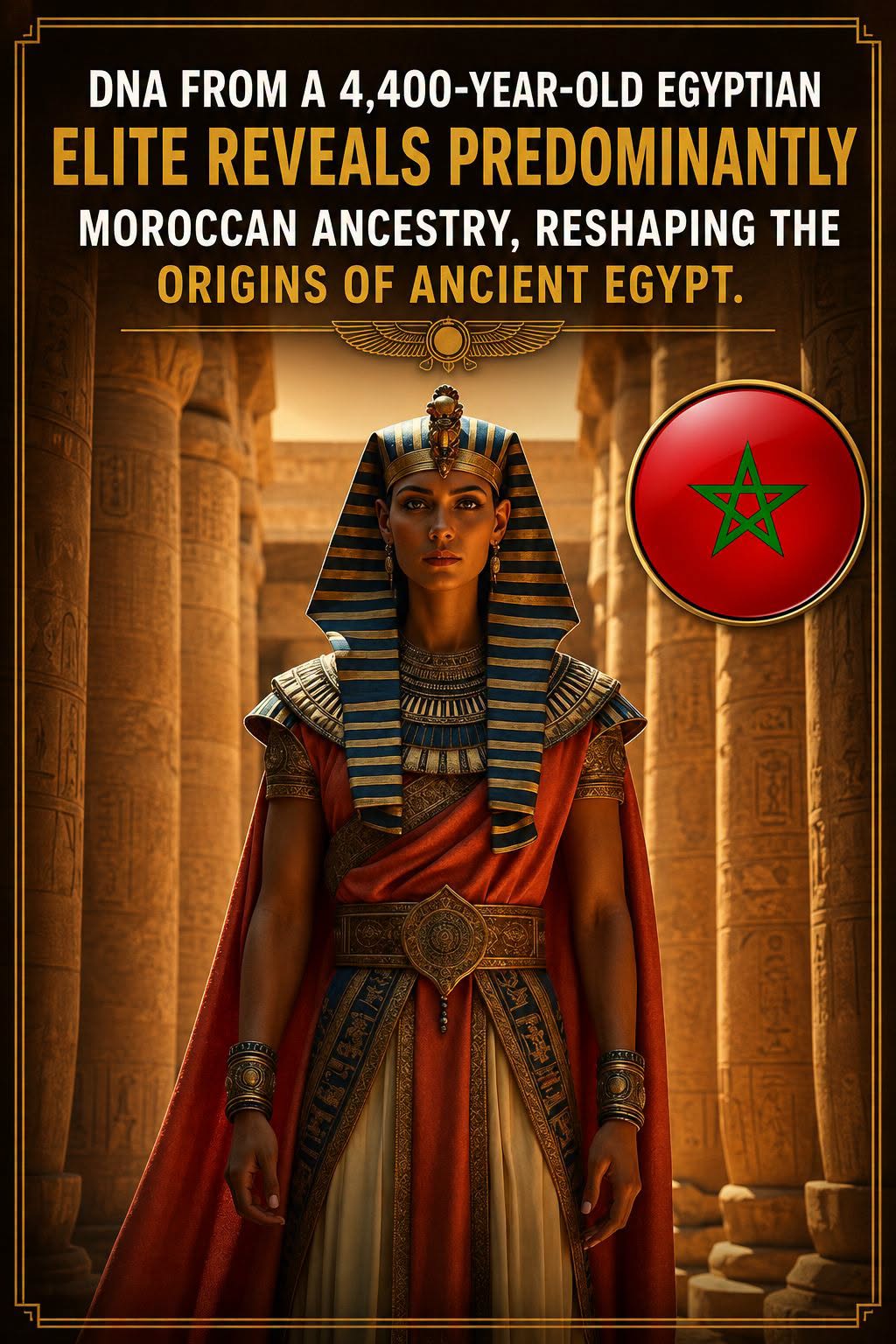
A 4,400-year-old skeleton buried deep in the sands of Middle Egypt has just rewritten part of human history. Discovered in the Nuwayrat necropolis, this individual was no ordinary citizen. He was a high-ranking official during the Old Kingdom—one of the most iconic periods in ancient Egyptian history. But it is not his tomb or status that stunned scientists—it is his DNA.
For the first time ever, researchers have reconstructed the full genome of someone from this era, and what they found challenges everything we thought we knew about Egypt’s past. The DNA analysis revealed a surprising ancestry mix. A massive 77.6 percent of this man’s genetic makeup traces back to Neolithic Moroccan populations. The remaining 22.4 percent aligns with early Mesopotamian farmers. This means that ancient Egypt was not a sealed-off civilization in the Nile Valley. It was a thriving crossroads of people, culture, and ideas stretching across vast distances in Africa and the Middle East.
This discovery sheds light on long-distance migration and trade routes that existed thousands of years before the invention of writing. It proves that early North African populations were highly mobile and interconnected. Egypt’s elite, including the man in this study, may have descended from diverse and far-reaching lineages. This breaks down outdated views of Egyptian identity being isolated or homogenous. Instead, it highlights a rich and dynamic population shaped by thousands of years of movement and exchange.
The fact that scientists could extract and sequence this DNA from remains over four millennia old is groundbreaking. It opens the door to deeper genetic studies that could answer even more questions about ancient civilizations and their origins.
Fun Fact: This is the first time a complete genome has been sequenced from an Egyptian official of the Old Kingdom era, revealing links that reach all the way to Morocco and Mesopotamia.
#MockingMerriment #AncientDNA #HumanHistory #OldKingdom #MigrationHistory #FossilDiscovery
#Archaeology #Paleogenetics #AncientEgypt #DNARevealsHistory
Leave a Reply
You must be logged in to post a comment.