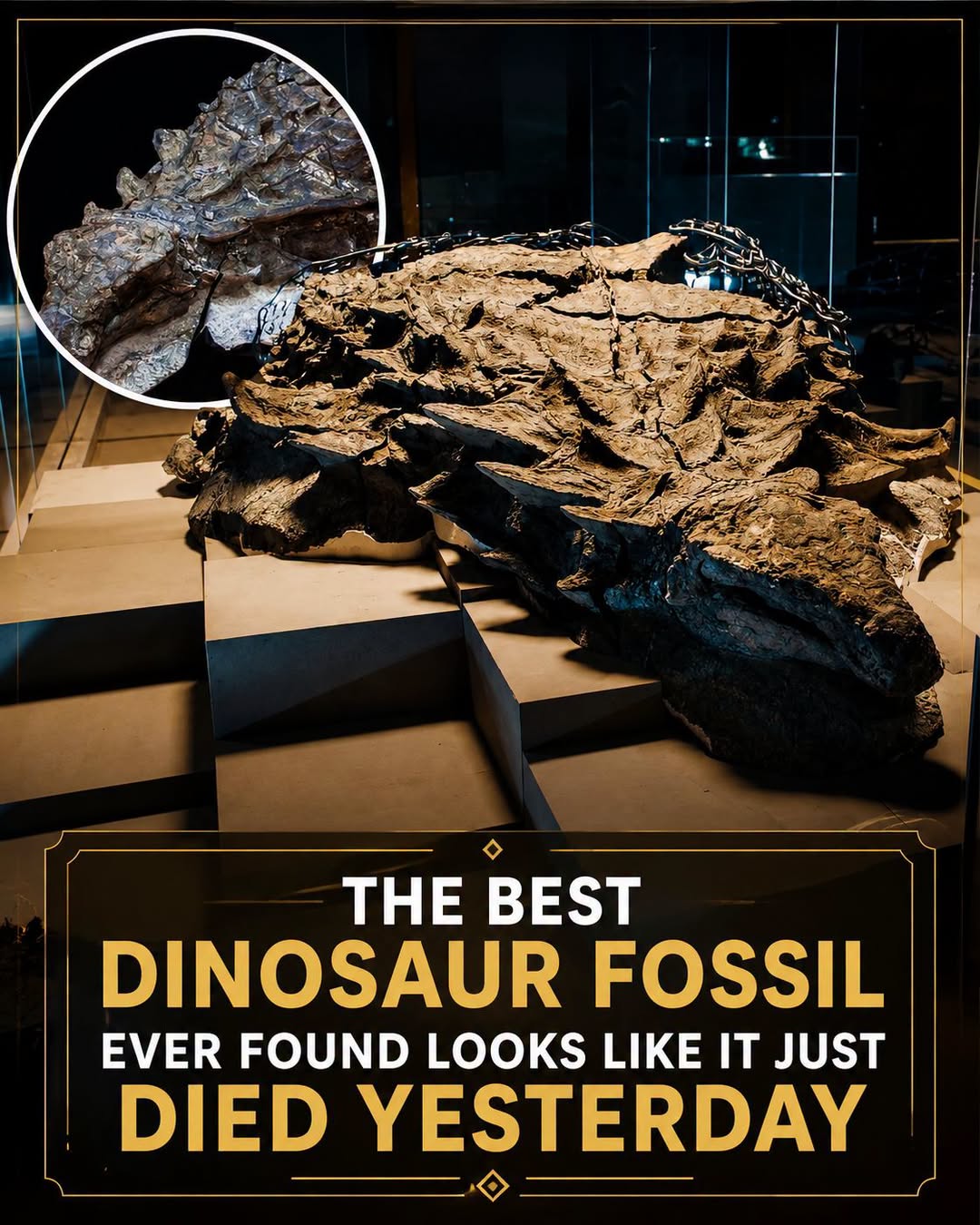
In 2011, miners working in Alberta, Canada, stumbled upon one of the most astonishing fossil discoveries ever made. What they uncovered wasn’t just bones. It was a 110-million-year-old nodosaur, preserved so perfectly that scientists could see the texture of its scaly skin, the armour on its back, and even the pattern on the sole of its foot.
This remarkable creature, now displayed at the Royal Tyrrell Museum, weighed about 2,500 pounds and stretched over 18 feet long. Unlike its ankylosaur cousins, the nodosaur didn’t have a tail club. Instead, it was built like a natural tank, protected by thick plate armour and powerful shoulder spikes that likely deterred even the fiercest predators of its time.
What makes this nodosaur truly unique is how it was preserved. Scientists believe it died in or near a river and was swept out to sea, where it quickly sank and was buried under layers of sediment. This rapid undersea burial protected the body from scavengers and decay, fossilising not just the bones, but the soft tissue and even cellular structures. The result is so life-like that it feels as if the creature could rise and walk at any moment.
Palaeontologists refer to this fossil as the “Rosetta Stone of armoured dinosaurs,” because of the incredible detail it reveals about the anatomy and biology of these prehistoric creatures. It’s helping scientists understand how these animals looked, moved, and survived during the Early Cretaceous period.
Fun Fact: This nodosaur’s fossilised skin still shows preserved pigment patterns, giving scientists rare clues about its potential colouration in life.
#MockingMerriment
#FossilDiscovery #FossilFinds
#Nodosaur #PrehistoricLife #RoyalTyrrellMuseum #ArmouredDinosaurs #CretaceousPeriod #Paleontology #Dinosaurs
Leave a Reply
You must be logged in to post a comment.