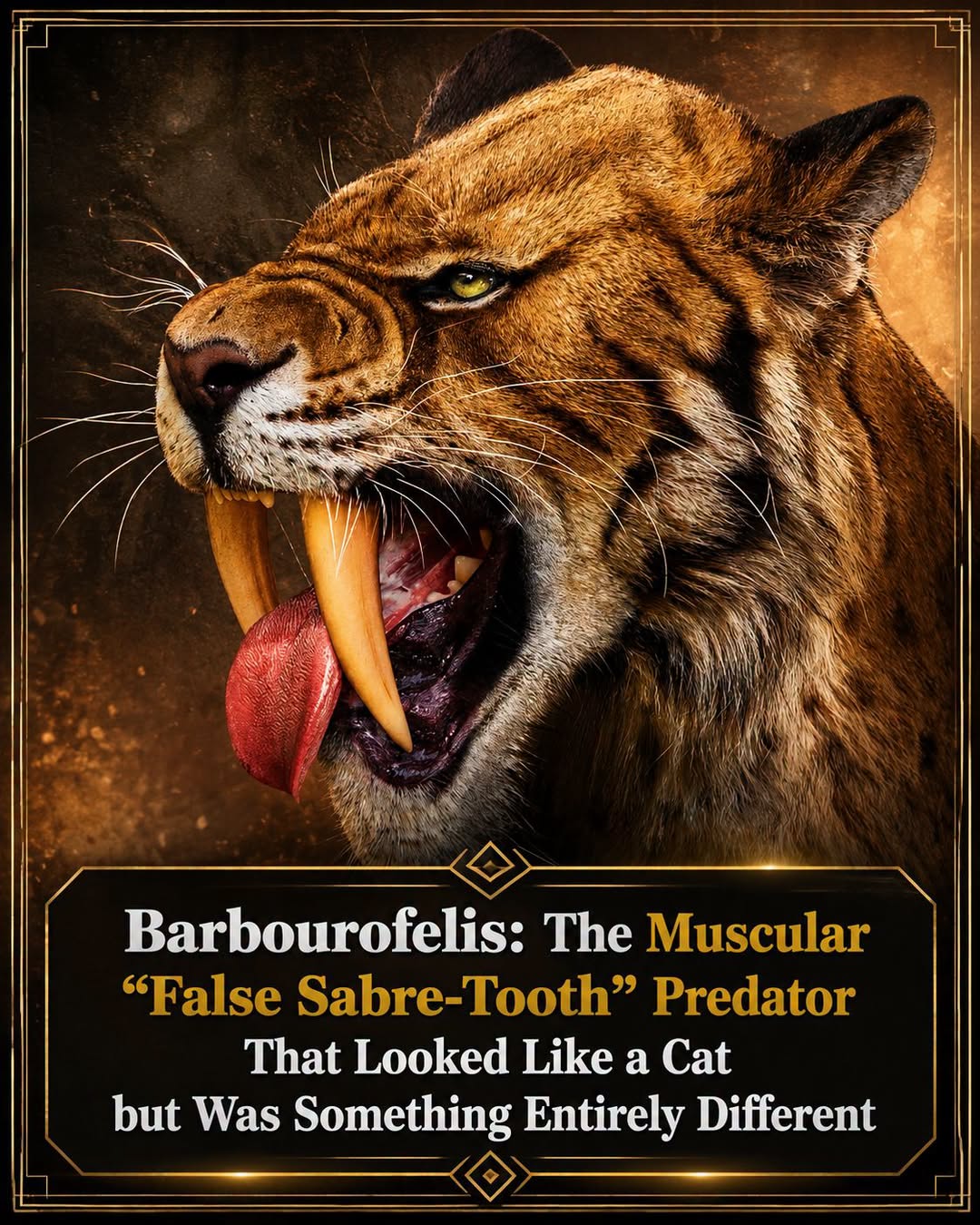
With massive fangs and a muscular frame, Barbourofelis looked like it belonged in the world of big cats, but it was something entirely different. This fearsome creature roamed North America during the Pliocene epoch and is one of the best-known examples of a “false sabre-tooth cat”—a group of predators that evolved to resemble true sabre-toothed cats, even though they weren’t closely related.
Reaching up to 1.8 metres in length, Barbourofelis was a heavily built carnivore, with a strong and stocky skeleton that points to immense muscle mass. Its body was built for power, not speed. Fossil evidence suggests that it used ambush tactics rather than chasing down its prey. With large, sharp canine teeth and a broad skull, Barbourofelis likely hunted large herbivores such as early horses, camels, and even juvenile mastodons.
What makes Barbourofelis so fascinating is its place in the evolutionary tree. It belonged to a now-extinct family of carnivorous mammals called Barbourofelidae. These animals are thought to be more closely related to modern-day hyenas and mongooses than to cats, despite their cat-like appearance. This is a classic example of convergent evolution, where unrelated species evolve similar traits due to similar lifestyles or ecological roles.
Barbourofelis also had unique features compared to other sabre-toothed predators. Its lower jaw had flanges, or bony extensions, that likely protected its long upper canines when the mouth was closed. These adaptations made it a highly specialised predator, uniquely suited for its time and environment.
Fun Fact: Despite its feline looks, Barbourofelis was not a true cat and is more closely related to animals like civets and genets than to lions or tigers.
#MockingMerriment
#Barbourofelis #AncientPredators #FalseSabretooth #Paleontology #ConvergentEvolution #FossilDiscovery #Pliocene #PrehistoricLife
Leave a Reply
You must be logged in to post a comment.