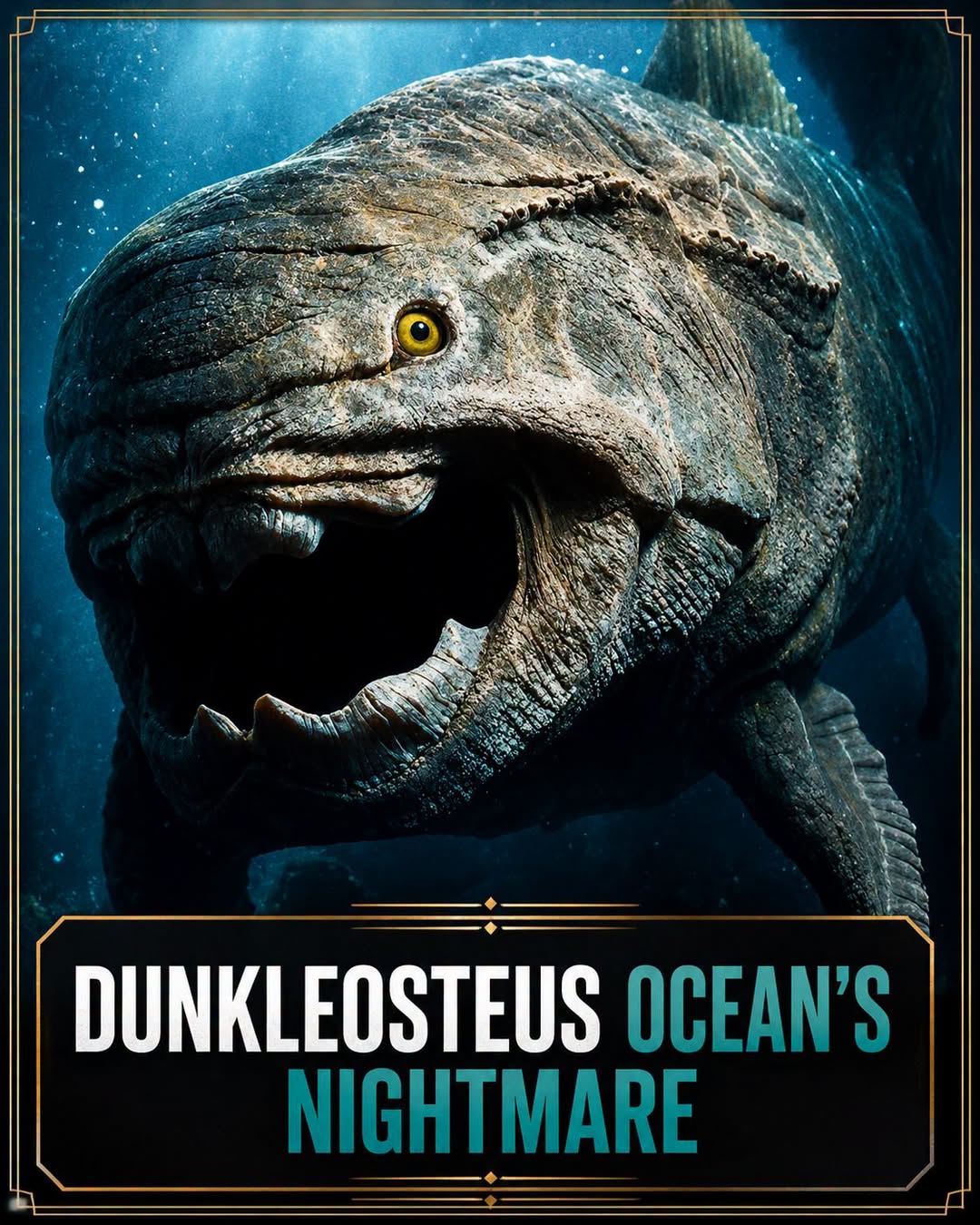
With a face like a tank and jaws that could slice through bone, Dunkleosteus ruled the ancient oceans long before the age of dinosaurs. This extinct genus of giant arthrodire fish swam the open waters during the Late Devonian period, around 382 to 358 million years ago, earning its place as one of the earliest known apex predators in Earth’s history.
As a pelagic hunter, Dunkleosteus thrived in deep, open waters and grew to massive lengths, with some specimens estimated at over 30 feet long. Its head and front torso were encased in thick dermal armour made from large, bony plates. While popular sources often claim this armour was 2 to 3 inches thick throughout the body, this was only true in select areas like the nuchal plate at the back of the skull. The rest of its body had thinner plating, measuring roughly 0.33 to 1 inch in thickness.
What truly sets Dunkleosteus apart is the structure of its bones. The plates had both a hard outer cortical layer and an inner spongy, marrow-filled cancellous layer. This composition is more similar to tetrapod bones than to those of most modern fishes, hinting at the complex evolutionary developments already taking place in early vertebrates.
Instead of teeth, Dunkleosteus had sharp bony blades that formed part of its skull, capable of delivering a bone-crushing bite. Its rapid jaw motion allowed it to create suction to pull prey in before slicing them apart, making it one of the most efficient marine predators of its time.
Fun Fact: Dunkleosteus belongs to a group of fishes known as arthrodires, meaning “jointed neck,” which allowed it to open its massive jaws wide without sacrificing skull protection.
#MockingMerriment
#Paleontology #DevonianPeriod #MarinePredators #FossilFacts #Dunkleosteus #Placoderms #ApexPredator
#PrehistoricLife #AncientOceans
Leave a Reply
You must be logged in to post a comment.