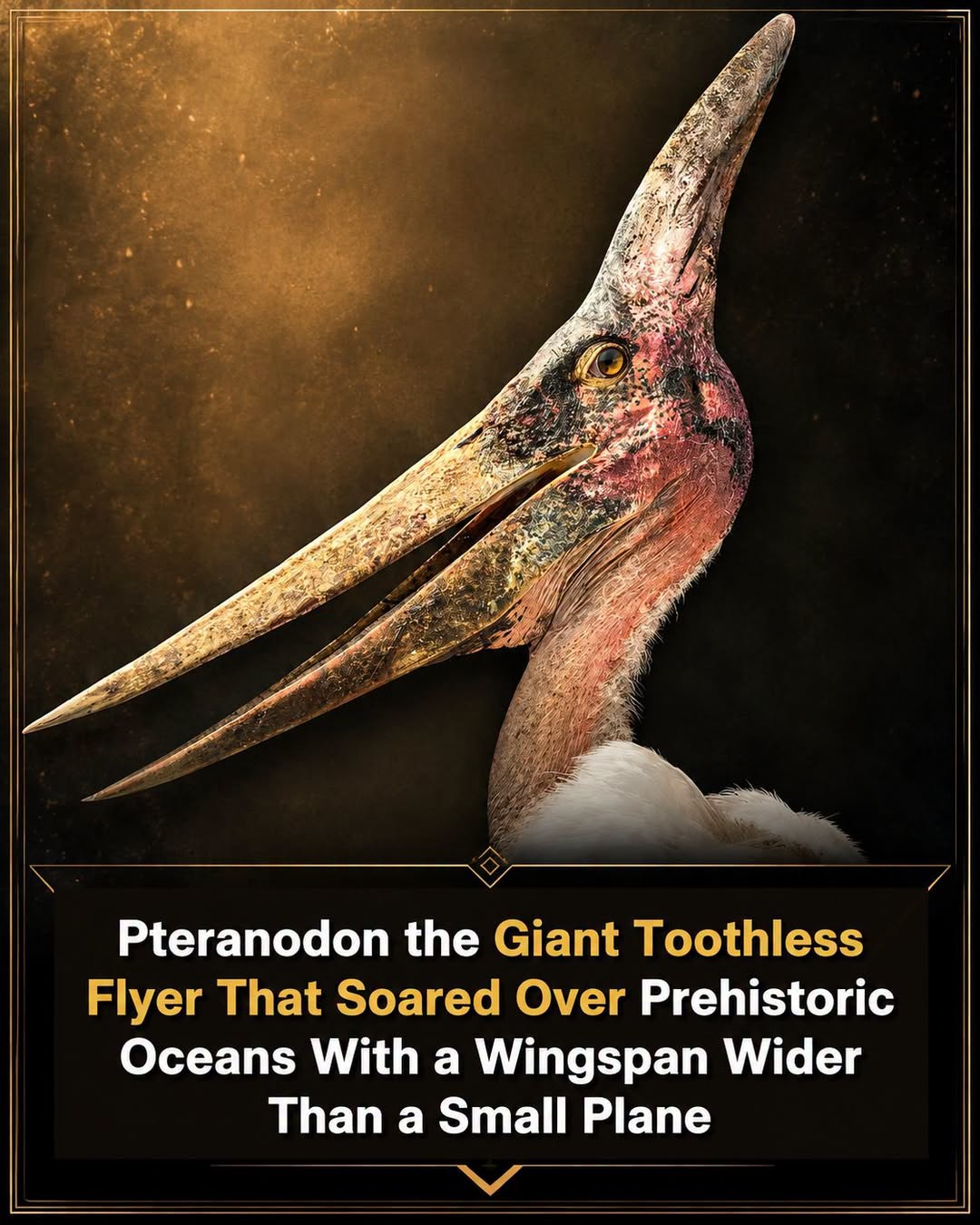
It had no teeth, but it ruled the skies like a silent giant. Pteranodon was not a dinosaur but a flying reptile, one of the largest ever to take to the air during the late Cretaceous period. With wingspans stretching over 7 metres, these extraordinary creatures glided above the warm coastal seas of what is now North America, searching for fish and other marine life.
The hookline? Pteranodon flew without a single tooth in its beak, relying instead on speed, precision, and its sharp-edged jaws to snatch prey mid-flight. Its long, lightweight skull featured a distinct upward curve in the upper jaw, and that massive crest at the back of the head helped with stability in flight. Males often had much larger crests than females, possibly for attracting mates or steering during long glides. Their beaks were stork-like, long and sharp, ideal for dipping into water to grab fish.
Despite their massive wings, their bones were hollow and light—an evolutionary advantage that allowed for efficient soaring over vast distances. Pteranodon is often mistaken for a dinosaur, but it actually belongs to a separate group called pterosaurs. Unlike birds, it had no feathers. Its wings were formed by skin and muscle membranes stretched across elongated finger bones, a unique design among flying creatures.
Some researchers suggest that Pteranodon may have nested on cliffs or rocky shores, gliding effortlessly from high points and using air currents to conserve energy. Others believe it may have launched from water, flapping powerfully with its strong forelimbs before catching lift.
Fun Fact: Though it had a giant wingspan, the body of Pteranodon was relatively small and lightweight. Its brain was also surprisingly large compared to its body, especially the parts associated with balance and vision, giving it impressive aerial control.
#MockingMerriment
#Pterosaur #Paleontology #AncientFliers #Pteranodon #Evolution #FossilDiscovery #MarinePredators #CretaceousPeriod #PrehistoricLife
Leave a Reply
You must be logged in to post a comment.