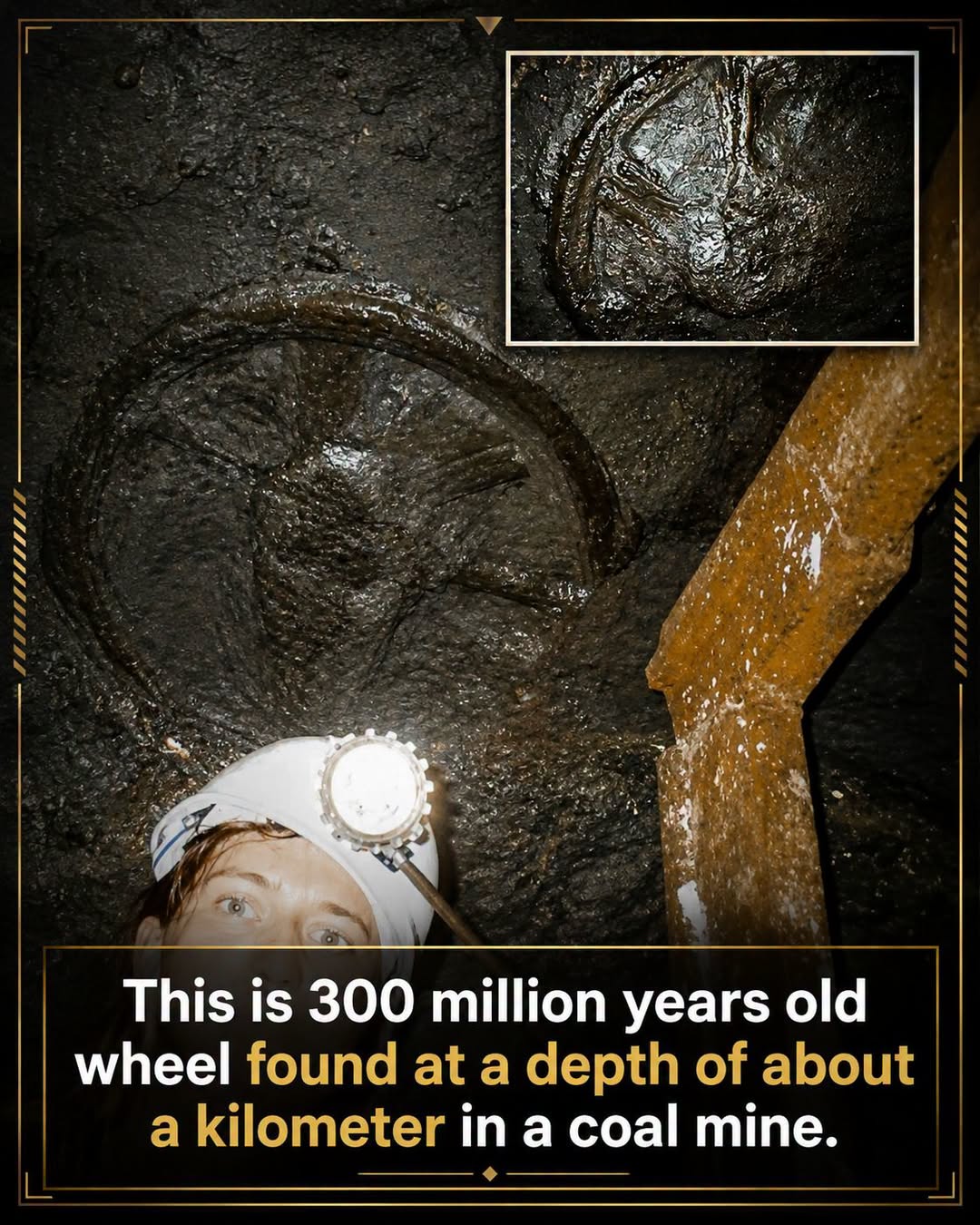
Deep beneath the Earth’s surface, miners in the Rostov region near Donetsk, Russia, stumbled upon a mystery that still defies explanation. In 2008, while drilling at a depth of around 900 metres into a coal seam known as the J3 ‘Sukhodolsky’ layer, workers uncovered what appeared to be a fossilised wheel imprint embedded in sandstone above the tunnel they had just excavated.
The discovery was made in Carboniferous-era rock, which dates between 360 and 300 million years ago—long before humans, mammals, or even dinosaurs walked the Earth. Coal seams in this region are formed from ancient swamps that existed during the middle to late Carboniferous period, making the supposed imprint even more puzzling.
Photos of the anomaly were taken by Deputy Chief V.V. Kruzhilin and shared with mine foreman S. Kasatkin, who reported the find. Unfortunately, due to the nature of mining operations, the imprint was never fully excavated or preserved for further analysis. The site was filled in for safety reasons, and no physical sample of the formation was taken.
Scientists remain cautious. Without proper study, it’s difficult to determine whether the structure is a natural formation that only resembles a wheel or an imprint left by something artificial. However, the region’s geology supports the age of the coal layers and raises the question of how such a shape could appear in 300-million-year-old rock. Geological processes like diagenesis can preserve the shapes of objects that dissolve over time, much like fossils. If it was once a real wheel-like object, it may have left its imprint before being replaced by surrounding sediment.
Fun Fact: The Carboniferous period, where this imprint was found, predates not only humans but all dinosaurs by more than 70 million years.
#MockingMerriment
#AncientMysteries #CarboniferousPeriod #FossilFacts #PrehistoricLife #EarthHistory
#Paleontology #UnexplainedFinds #Geology #Archaeology
Leave a Reply
You must be logged in to post a comment.