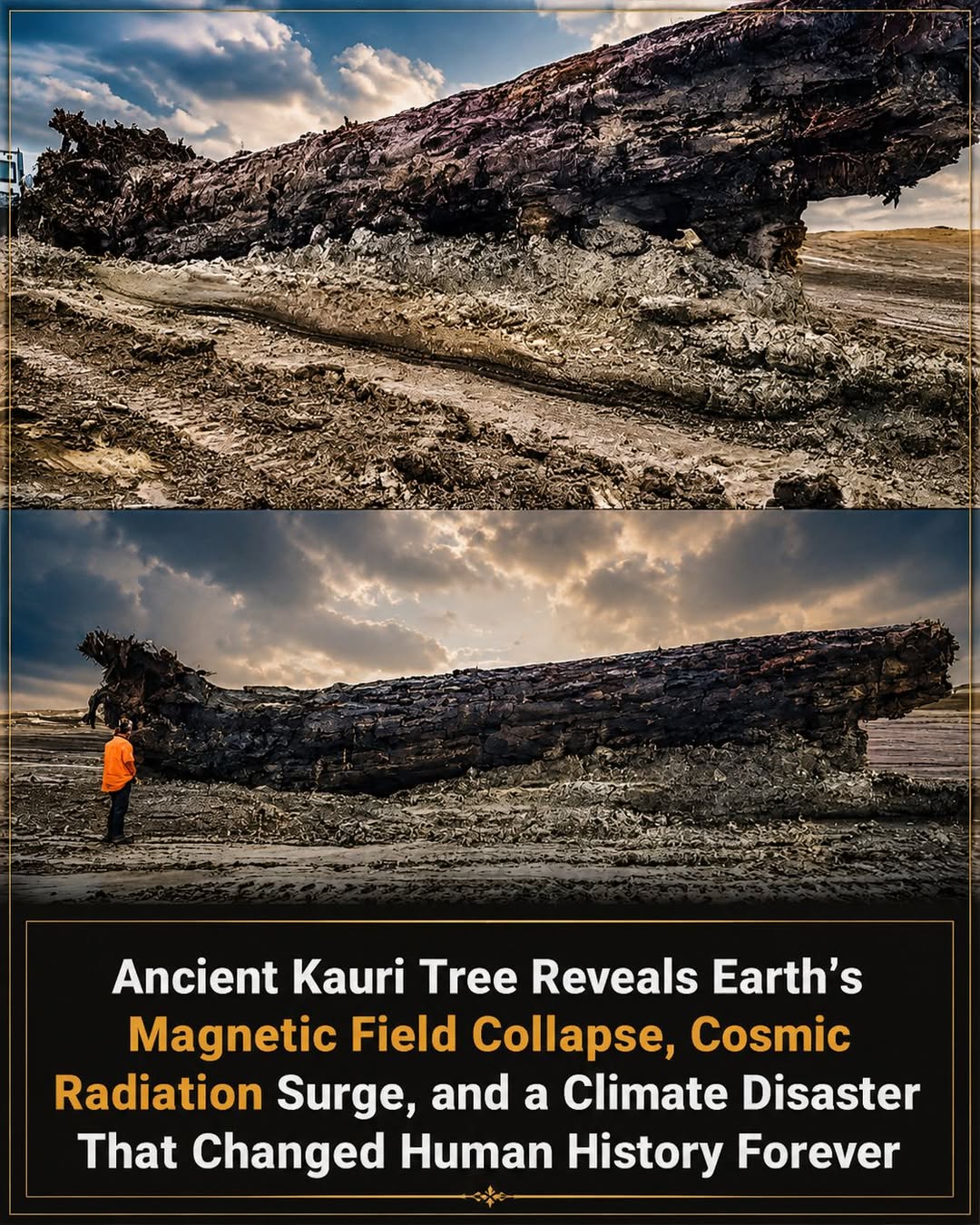
Buried in a New Zealand swamp for more than 40,000 years, an ancient kauri tree has become one of the most important botanical discoveries in climate science and prehistoric studies. Perfectly preserved in sediment, this massive tree lived during one of the most volatile moments in Earth’s recent past: the Laschamp Excursion, a rare reversal of the planet’s magnetic poles.
Even more critical is what happened just before this flip—the Adams Event. During this time, Earth’s magnetic field nearly vanished, weakening to as little as 0 to 6 percent of its usual strength. With the shield down, Earth was bombarded by intense solar and cosmic radiation, altering the climate dramatically. Ice sheets expanded, deserts replaced fertile land, and storm systems shifted in strange and violent ways.
The tree’s rings preserved the timeline of these environmental shocks with unmatched detail. Scientists believe this chaos may have contributed to the extinction of Neanderthals and forced early Homo sapiens into caves for survival, where they began crafting the earliest symbolic cave art known to archaeology. The Adams Event, then, was not just a magnetic hiccup—it may have been a turning point in human history itself.
Today, this kauri tree is more than just an ancient relic. It is a living record of a dying field, offering clues to what could happen if Earth’s magnetic shield weakens again. With our growing dependence on satellites and electronics, a repeat of the Adams Event could cripple global communication and climate stability.
Fun Fact: The kauri tree’s rings allowed scientists to reconstruct atmospheric radiocarbon levels from 42,000 years ago, offering unprecedented insight into Earth’s ancient climate.
#MockingMerriment
#LaschampExcursion
#MagneticField #PrehistoricLife #AdamsEvent #AncientTrees #HumanEvolution #KauriTree #Paleontology #ClimateScience
Leave a Reply
You must be logged in to post a comment.