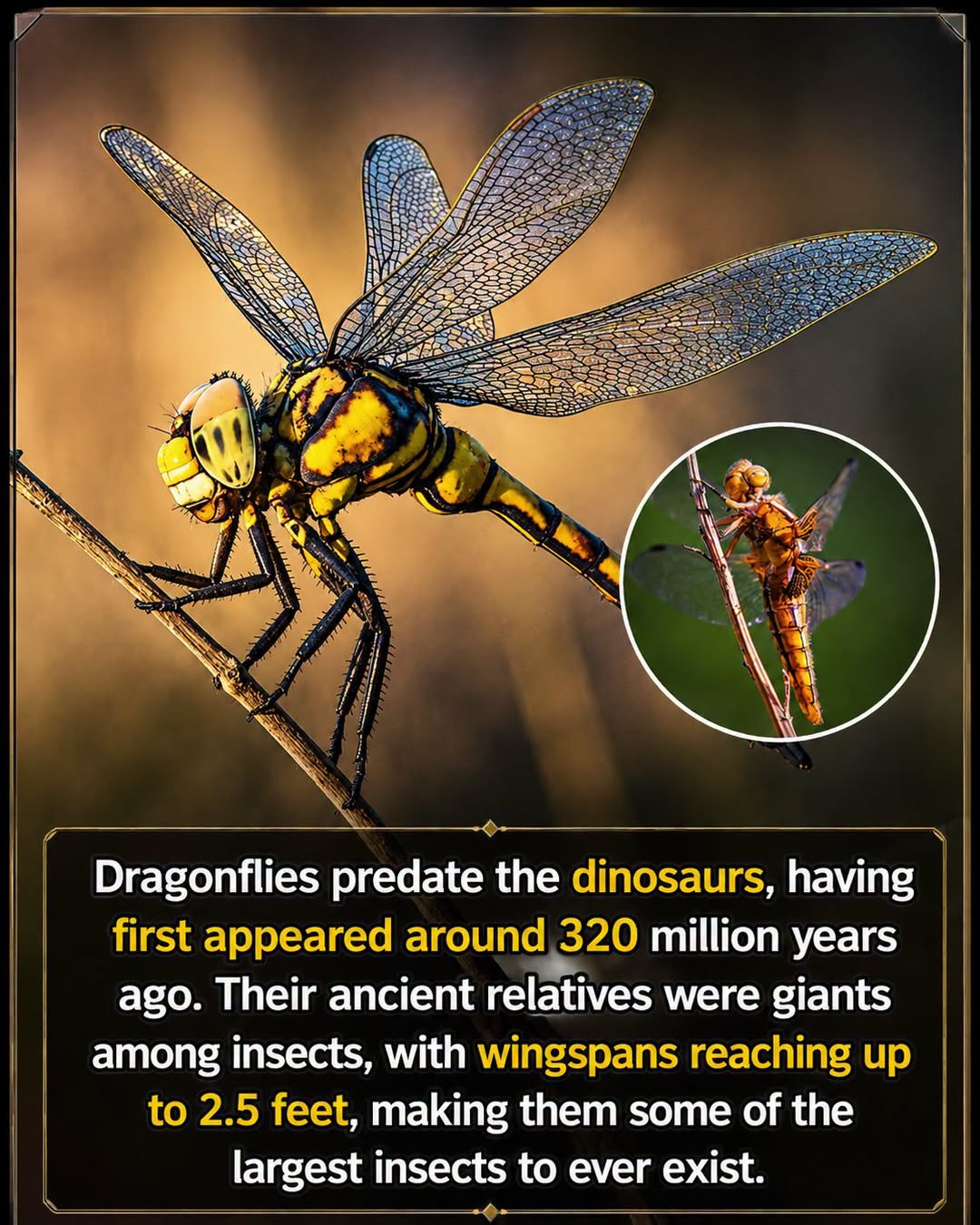
Long before dinosaurs ever walked the Earth, the skies were ruled by truly massive insects. Among the most impressive were the prehistoric relatives of modern dragonflies, some of which had wingspans reaching up to 2.5 feet. These ancient predators first appeared around 320 million years ago during the Carboniferous period, making them some of the earliest known flying insects in Earth’s history.
These giant dragonflies belonged to the now-extinct order Meganisoptera, with the most famous genus being Meganeura. They resembled modern dragonflies in shape and behaviour but were far larger and likely even more fearsome. Fossil evidence shows they hunted other insects and possibly small vertebrates, using their powerful jaws and exceptional flying agility. At the time, Earth’s atmosphere contained higher oxygen levels than today, which may have enabled these insects to grow to such enormous sizes.
The artistic rendering in this post dramatically captures what one of these ancient giants might have looked like in flight, while the inset image of a modern dragonfly offers a striking comparison. The evolution of dragonflies over hundreds of millions of years has resulted in the smaller, streamlined species we see today, but their core design has remained remarkably consistent. Their large eyes, strong wings, and exceptional flying abilities are features that have stood the test of time.
Giant dragonflies were part of a larger ecosystem that looked nothing like today’s world. Dense swamp forests, towering horsetails, and giant arthropods created a landscape as alien to us as any distant planet. These creatures were apex aerial hunters long before dinosaurs ever emerged.
Fun Fact: Dragonflies can see in nearly every direction at once, thanks to their compound eyes, which have up to 30,000 facets.
#MockingMerriment
#GiantDragonflies #Evolution #FossilDiscovery #Meganeura #PrehistoricLife #ApexPredators
#Paleontology #CarboniferousPeriod #AncientInsects
Leave a Reply
You must be logged in to post a comment.