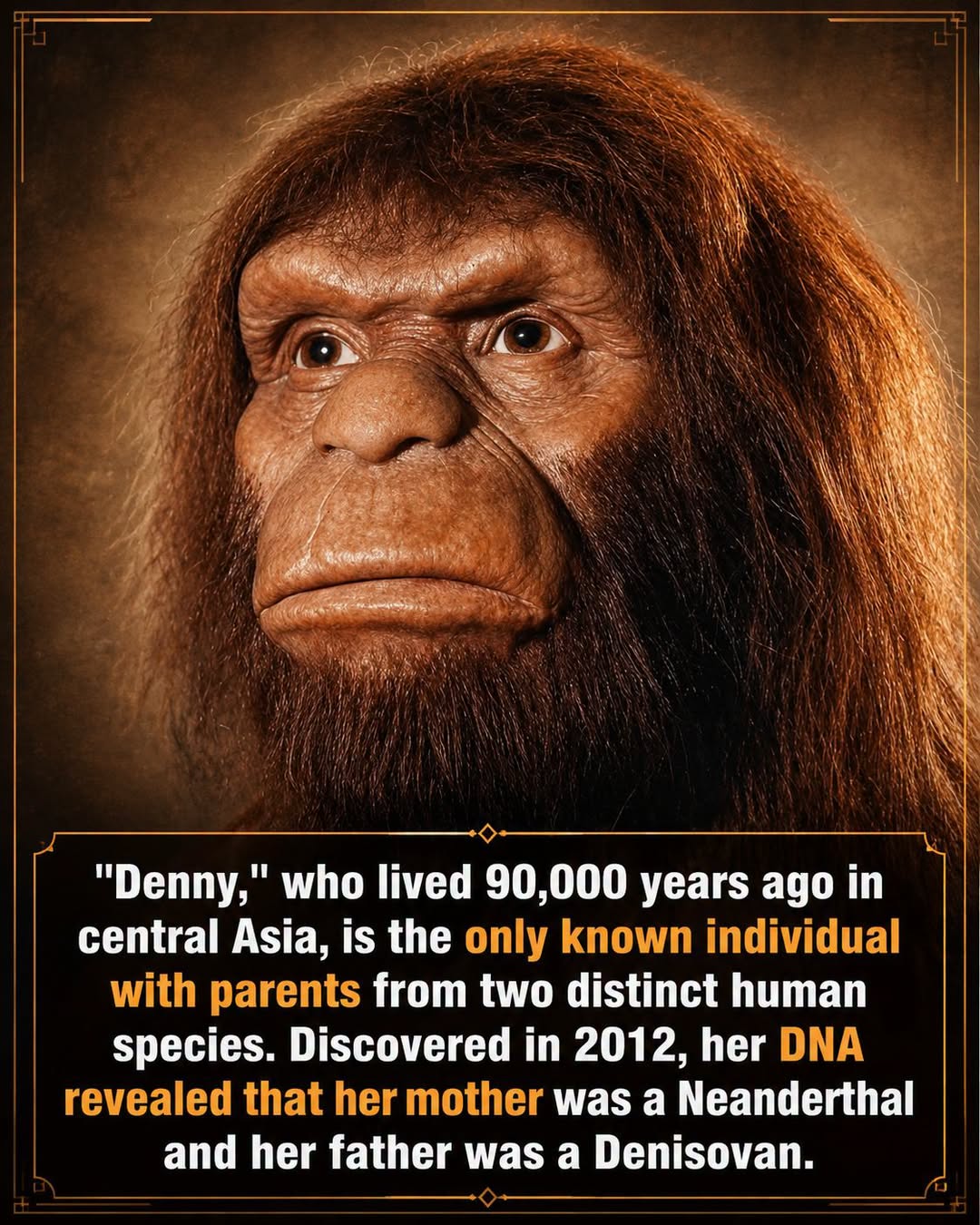
What if a single bone could rewrite everything we thought we knew about human evolution? In the heart of Siberia’s Denisova Cave, buried among thousands of tiny bone fragments, scientists discovered a relic that would shake up the story of our ancient past. It belonged to a young girl now known as “Denny”—who lived around 90,000 years ago. But she wasn’t just any ancient human. She was the first known hybrid of two entirely different human species: her mother was Neanderthal and her father was Denisovan.
That one tiny fragment, no bigger than a thumb, revealed something never seen before. Her DNA was almost exactly split down the middle between Neanderthal and Denisovan, proving her parents came from two distinct human groups that had been evolving separately for hundreds of thousands of years. Her Denisovan father even carried older traces of Neanderthal DNA, suggesting these ancient groups had a history of mixing far more often than previously thought.
What makes this even more remarkable is where it happened. Neanderthals mostly roamed Europe and western Asia, while Denisovans lived in the east. For them to meet—and for a child like Denny to be born—these groups had to travel, migrate, and cross landscapes filled with challenges we can only imagine. It also hints at complex relationships and repeated contact between different early humans, long before the rise of Homo sapiens.
Denny’s story challenges the old idea that ancient humans lived in separate worlds. Instead, it shows a connected web of interactions, migrations, and interbreeding that shaped the human journey in ways we’re still trying to understand.
Fun Fact: Denny’s entire existence was uncovered from a single fragment of bone just 2 centimetres long. And yet, she may hold one of the biggest secrets in human evolutionary history.
#MockingMerriment
#HumanEvolution #DenisovaCave #Denisovan #Neanderthal #Genetics #Archaeology #Paleontology #AncientHumans #PrehistoricLife
Leave a Reply
You must be logged in to post a comment.