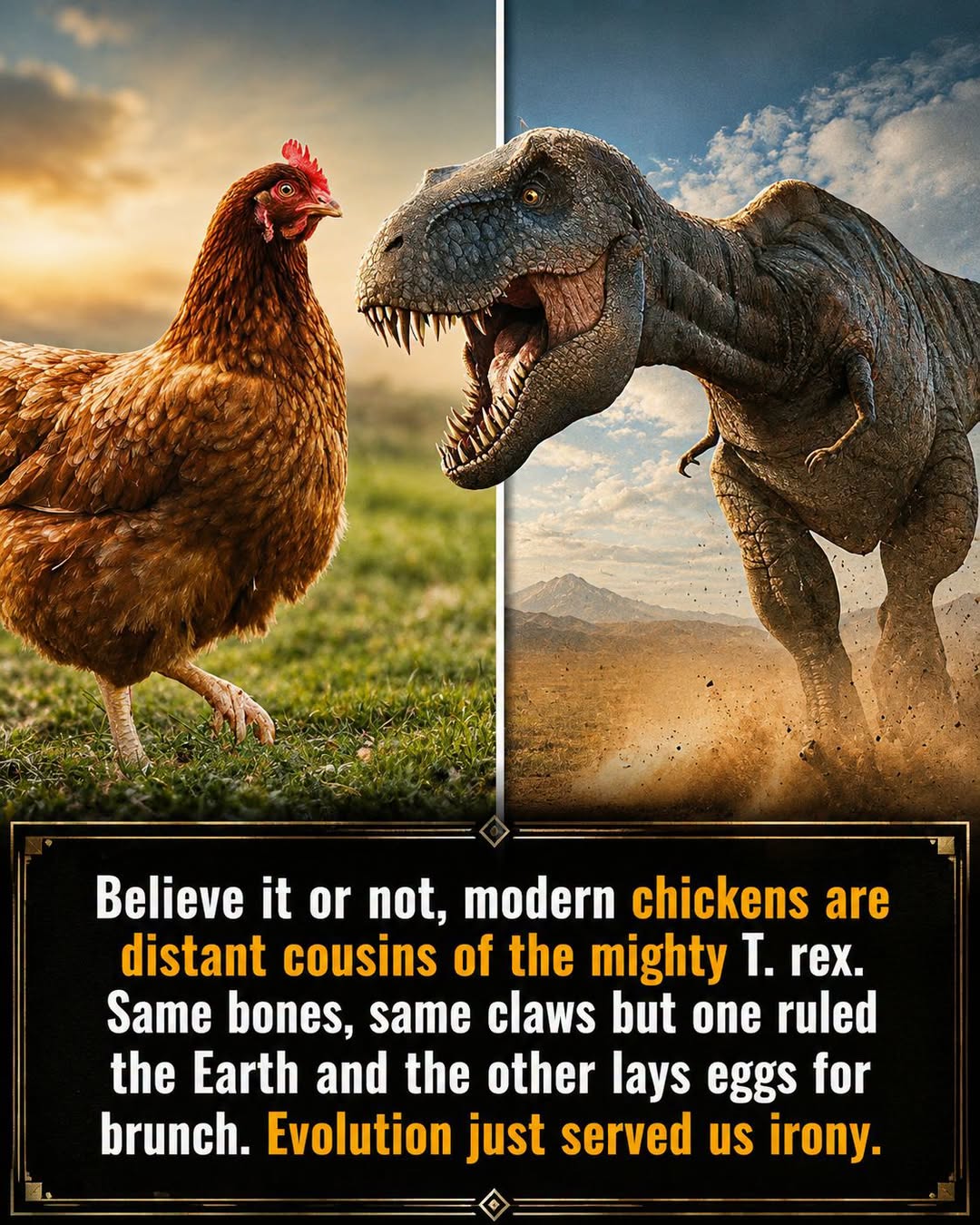
Tyrannosaurus rex, one of history’s most feared predators, may have more in common with a chicken than with a crocodile. It’s not science fiction—it’s hard science. In 2008, researchers analysed the protein remains of a 68-million-year-old T. rex and found something astonishing: molecular similarities with modern birds.
While dinosaurs went extinct around 66 million years ago, they didn’t vanish without leaving a genetic trail. Scientists from Harvard University and other institutions managed to extract collagen, a structural protein, from an exceptionally well-preserved T. rex bone. This was a major achievement, as organic materials rarely survive fossilisation. The team then compared the dinosaur collagen to proteins from 21 living animals, including humans, mice, salmon, alligators, chickens, and ostriches.
The closest matches weren’t reptiles—they were birds. Specifically, chickens and ostriches shared the most similarities with the ancient predator. This gave strong molecular support to the long-standing theory that birds are the direct descendants of theropod dinosaurs like T. rex. While the findings didn’t pinpoint one bird as the sole closest relative, they placed T. rex on the evolutionary tree somewhere between modern alligators and birds.
The results highlight how dinosaurs didn’t vanish completely—they evolved into the feathered creatures we see today. This discovery reinforced the idea that many dinosaurs likely had feathers and were far more birdlike than pop culture has often portrayed.
So the next time you watch a chicken pecking at the ground, you might just be looking at a distant echo of one of Earth’s most legendary hunters.
Fun Fact: Chickens are genetically closer to T. rex than to modern reptiles like lizards or snakes, based on molecular evidence.
#MockingMerriment #Evolution #MolecularBiology #Paleontology #TyrannosaurusRex #BirdAncestors #FossilDiscovery #PrehistoricLife #Dinosaurs #Theropods
Leave a Reply
You must be logged in to post a comment.